
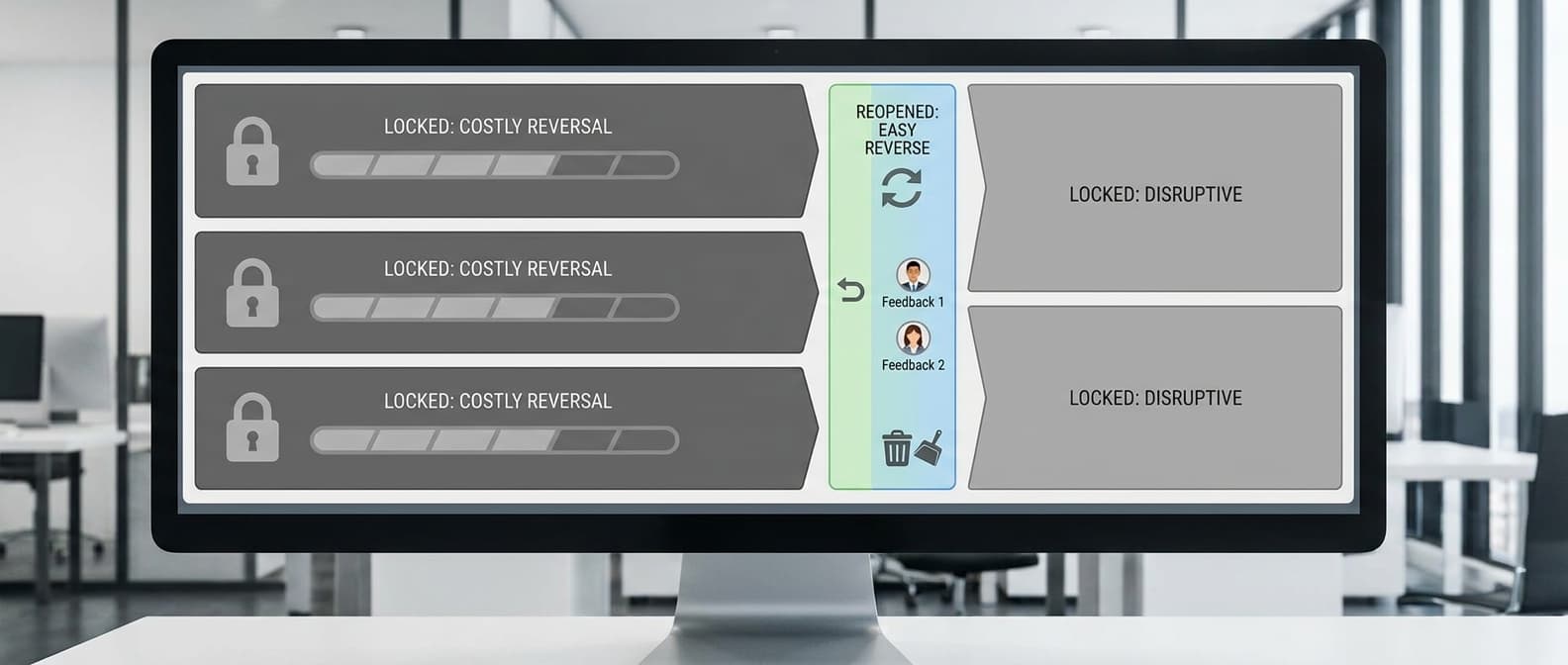
Teams usually talk about reopening an AI workflow in terms of risk.
That makes sense, up to a point.
If a workflow lost trust and came back under narrower approval, nobody wants the first restored lane to be the one with the biggest blast radius.
But I think a lot of teams stop one question too early.
If the first live lane misfires, how expensive is it to undo.
That question matters because a restored lane is still on probation, even if nobody uses that word out loud.
The point of the first lane is to prove the controls. It is not to create a cleanup bill that hides whether the controls were good enough in the first place.
Cheap reversal is part of control design
A lane can look reasonable in a workflow diagram and still be a bad first step back into production.
Maybe the direct action is small. Maybe the approval story sounds tidy. Maybe the team can explain why the lane is narrower than before.
Fine.
If one bad run still forces external repair, cross-team reconciliation, or a week of downstream cleanup, that lane is not a good proving lane.
The workflow may be constrained. The business outcome is still expensive.
That is the part I would want teams to treat as a control question, not just an operations annoyance after the fact.
The market is pushing buyers toward operating questions
The recent enterprise AI direction from OpenAI, Google, Anthropic, and Microsoft keeps pulling the conversation toward admin visibility, governed authority, intervention, and remediation.
That shift matters.
Once buyers start judging a workflow by who can see it, steer it, and stop it, they also start asking what happens after a miss lands.
Can the team reverse the outcome quickly.
Can one owner contain the damage.
Can the business learn from the run without paying for broad rework.
Those are production questions. They sit right next to observability and permissions, not behind them.
A bad first lane teaches the wrong lesson
This is the trap.
A team reopens a lane that looks bounded, then a bad run lands and the cleanup is miserable. Finance has to unwind records. Support has to explain something awkward. Operations has to reconcile downstream effects in two other systems. Leadership walks away thinking the workflow still is not trustworthy.
Maybe that conclusion is right.
Maybe it is not.
If the first lane was expensive to unwind, the business just paid a large tuition bill to relearn a narrow control question.
That is not a good proving sequence.
The first restored lane should help the team learn cheaply. If the controls fail once, the mistake should be easy to correct and easy to inspect.
Low theoretical risk is not the same as low undo cost
I see teams blend those ideas together all the time.
A lane can look conservative because it starts with an internal draft, a limited output, or a smaller dataset. That still does not tell you what cleanup looks like if the draft gets trusted too quickly, pushes the wrong signal downstream, or forces a second team to repair the aftermath.
Undo cost has its own shape.
I would separate it into a few direct questions:
- If this run is wrong, what exact repair work follows?
- Can the same team that spots the issue also reverse it?
- Does cleanup stay internal, or does it spill into customer repair, ledger correction, or broad downstream rework?
- Is there another lane that proves the same controls with a smaller remediation bill?
If the answers are ugly, the lane may still be the wrong place to restart.
The first restored lane should be cheap to correct
That often means reopening the internal step before the external one.
A finance workflow should usually reopen analyst-facing draft support before anything that creates vendor-facing payment work.
A support workflow should usually reopen internal triage help before customer-visible response generation.
A developer-assistant workflow should usually reopen reviewed drafting work before anything that can create configuration drift or multi-environment cleanup.
The principle is simple.
Start where a mistake is still cheap to absorb. Earn the right to reopen the costlier lane later.
What MTL would want a team to prove first
When a workflow comes back under partial trust, I would want the first lane to show four things:
- The authority is narrower than before.
- The run is visible enough that an operator can explain what happened.
- The lane can be paused or redirected without heroics.
- A bad run is cheap enough to unwind that the business learns without paying for a mess.
That last point gets ignored too often.
Control design is not only about stopping damage early. It is also about choosing a proving lane where the cleanup path stays reasonable if the controls miss once.
The useful takeaway
A partially reapproved AI workflow should not reopen the most expensive-to-undo lane first.
The first lane back into production should teach the team something useful at a price the business can live with.
If one bad run would trigger customer repair, accounting cleanup, or broad cross-team reconciliation, that is usually not the lane I would use to earn trust back.
If your team is trying to decide which AI workflow lane should come back first, and how to narrow authority without creating expensive cleanup, book a discovery call here:
https://calendly.com/martintechlabs/discovery
FAQ
Why should a partially reapproved AI workflow start with the cheapest-to-undo lane?
Because the first live lane is still proving the controls. If one bad run lands, the business should be able to reverse it quickly and cheaply instead of paying for broad cleanup.
What makes an AI workflow lane expensive to undo?
A lane gets expensive to undo when a bad run creates customer confusion, ledger corrections, cross-team reconciliation, or broad downstream rework that takes longer than the original task.
How can a team evaluate cleanup cost before reopening an AI workflow lane?
The team should ask what exact repair work follows a bad run, who owns that repair, how many systems need correction, and whether another lane could prove the controls with less cleanup.
What is the difference between low risk and low undo cost in AI operations?
A lane can look low risk on paper and still be expensive to unwind if one bad output spreads across external messages, financial records, or multi-team workflows. Undo cost is its own operating test.