
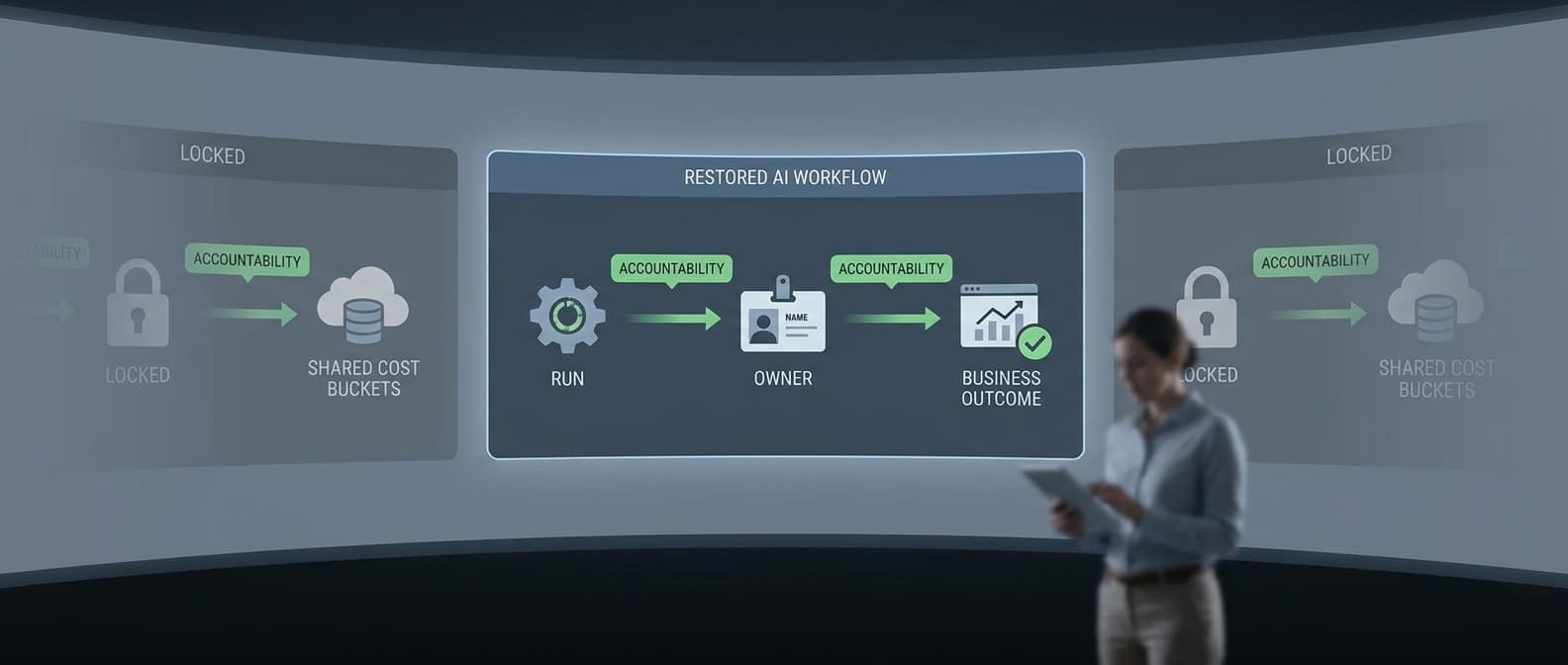
When teams talk about restoring an AI workflow, they usually focus on permissions, approvals, and blast radius.
That is reasonable. It is just not the whole decision.
If the workflow is only coming back under partial trust, I think the first question should also be economic.
Can the business tell where the spend came from.
Not in a vague monthly sense. I mean can one owner point to the lane, the run pattern, and the business purpose without doing a separate forensic project after the fact.
That matters because the first restored lane is still a proving lane. It should not only be safer to run. It should be easier to explain.
Narrow authority is not enough if the spend disappears into a shared bucket
A lane can look disciplined on paper.
Maybe the permissions are tighter. Maybe the approval step is back. Maybe the workflow only runs on a schedule now instead of on demand.
Fine.
If the business still cannot tie the resulting usage back to one accountable owner and one bounded purpose, that lane is weaker than it looks.
The problem is not just budget anxiety. The problem is operating clarity.
If spend rises, the team should be able to answer a few boring questions fast.
What lane caused it.
Who owns that lane.
Was the increase expected because of more legitimate work, or did the workflow drift into a path nobody meant to restore yet.
If those answers are slow or fuzzy, the lane is a poor first step back into production.
The market is making attribution harder to ignore
The current enterprise platform direction keeps pushing buyers toward admin visibility, governed usage, and operational accountability.
OpenAI is putting workspace agent activity and credit-based economics into the same buyer conversation. Google keeps reinforcing governed gateways, observability, and security findings. Anthropic keeps tightening connector permissions and role-scoped authority. Microsoft keeps framing live AI operations through governance, observability, and FinOps.
Different vendors, same lesson.
The business is being taught to ask who can see the runs, who can shape the authority, and what recurring usage looks like once the workflow becomes real work.
That means a restored lane should be chosen partly for cost lineage. If the usage trail is muddy, the trust story is muddy too.
A proving lane should be easy to defend
I think this is the practical test.
The first lane back into production should be simple enough that one operator can explain why the spend exists.
Not "our AI tooling got busier this month."
Something tighter than that.
This support-triage lane ran against this queue. These are the allowed actions. This is the connector path. This is why the usage rose. This is where we would see drift if the workflow started doing more than it should.
That is the kind of answer a business can operate.
If the lane lives inside a shared bucket where several teams, tools, or task classes all blur together, the workflow may still look controlled from an access standpoint while remaining weak from an accountability standpoint.
Weak spend attribution creates the wrong cleanup loop
When a restored lane has poor cost lineage, the first sign of trouble is often a messy argument.
Finance sees the usage move. Operations is not sure whether it came from normal volume or a bad workflow path. Engineering has to reconstruct which connector or task fan-out caused the change. Nobody is certain whether the issue is model usage, tool usage, repeated retries, or downstream exception labor.
That is not a healthy proving sequence.
The first restored lane should teach the business something cleanly. If usage changes, the team should know where to look and who has to answer for it.
Otherwise the company is relearning a basic governance question through noise instead of evidence.
Stable spend is not the same as attributable spend
This point gets missed all the time.
A lane can have predictable total usage and still be badly designed as a proving lane.
Maybe the monthly number barely moves. Good.
If nobody can map that usage back to one owner, one workflow purpose, and one allowed pattern of work, the lane is still weak.
Attribution is its own control.
I would separate it from volatility.
Volatility asks whether the spend jumps around in ways the business cannot predict.
Attribution asks whether the business can explain which restored lane created the spend at all.
Those are different operating questions. Both matter.
Five questions I would ask before reopening the lane
- Can one owner explain where this lane's usage should appear?
- Can the team trace a spike back to a specific run pattern, connector path, or task class without a separate investigation?
- Does the lane have one clear business purpose, or is it still mixed into shared infrastructure nobody really owns?
- If spend rises, will the right operator know whether the cause was model usage, tool fan-out, retries, or downstream exception handling?
- Is there another lane that proves the controls with cleaner cost lineage?
If those answers are weak, I would not use that lane as the first one back.
Start where usage has an obvious owner
This often means reopening the internal, narrower lane before the broader multi-team one.
A support workflow should usually reopen the queue where one operator owns triage outcomes before it reopens a mixed lane touching customer messaging and CRM updates across several teams.
A finance workflow should usually reopen exception summarization before it reopens a cross-system lane where the resulting work and usage disappear into several buckets.
A developer-assistant workflow should usually reopen one review queue before it reopens a wider lane spread across multiple repos, environments, and tool paths.
The common principle is simple.
Restore the lane where the business can tie usage to one accountable owner and one bounded purpose. Earn the messier lane later.
The useful takeaway
A partially reapproved AI workflow should not reopen the weakest spend-attribution lane first.
The first lane back into production should not only have narrower authority. It should also have cleaner economic lineage.
If the business cannot say who owns the usage, what work pattern caused it, and which business purpose justified it, the lane is probably too murky to be the first one that earns trust back.
If your team is trying to decide which AI workflow lane should come back first, and how to restore authority without losing cost accountability, book a discovery call here:
https://calendly.com/martintechlabs/discovery
FAQ
Why should a partially reapproved AI workflow start with a lane that has clear spend attribution?
Because the first restored lane is still proving the controls. The business should be able to tie usage back to one owner, one run pattern, and one business purpose before it reopens murkier automation.
What makes spend attribution weak in an AI workflow?
Spend attribution is weak when usage lands in shared buckets, several teams can trigger similar runs, or nobody can explain which workflow path caused a spike without a separate investigation.
How can a team test whether a restored AI lane has clean cost lineage?
The team should ask who owns the lane, where its usage should appear, what task classes belong to it, and whether a spike can be traced back to a specific run, connector path, or downstream action.
Why is cost traceability part of production AI governance?
Because a workflow is harder to trust when the business cannot tell which operator, workflow lane, or allowed action created the usage. Traceability is part of accountability.