
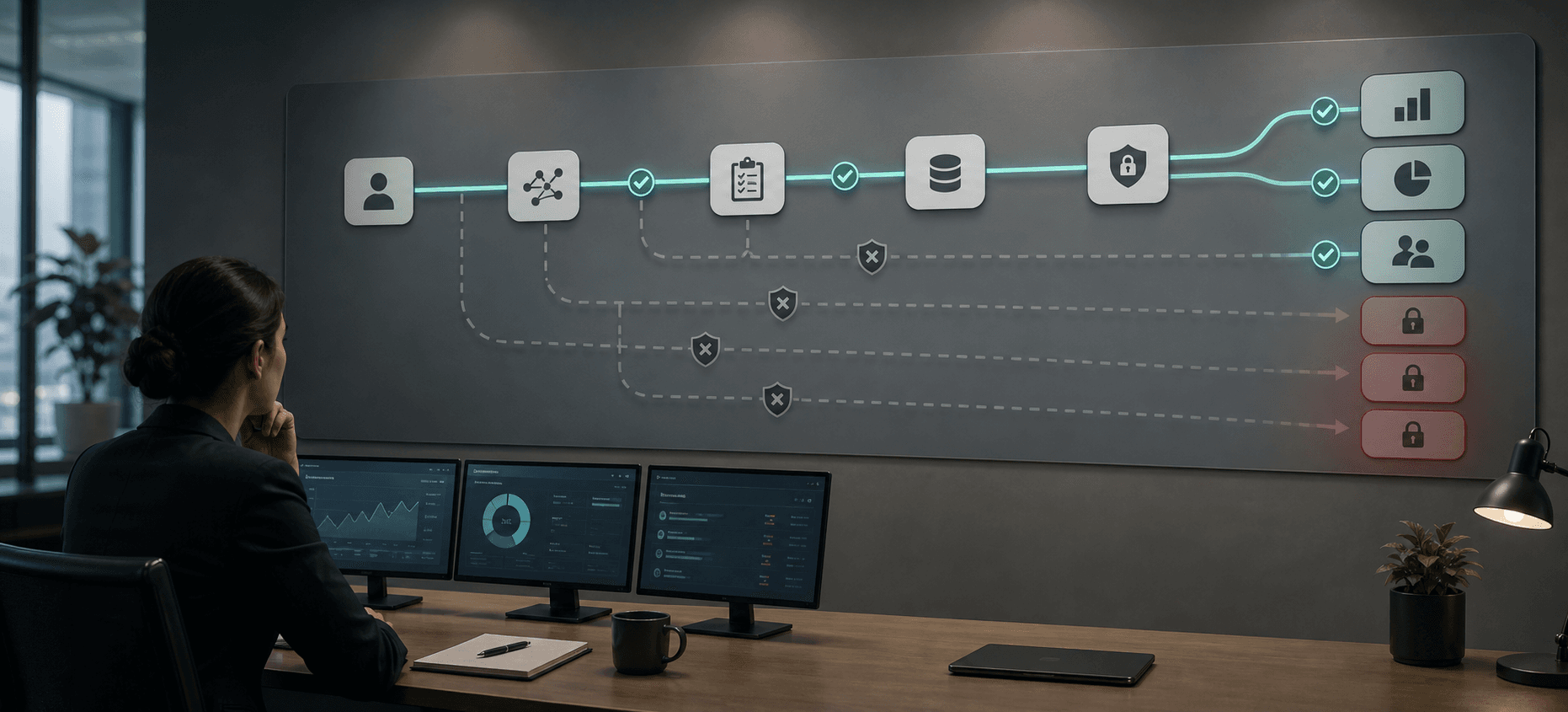
There is a mistake I keep seeing in AI rollout conversations.
Teams act like a good prompt is doing more security work than it really is.
They tighten the instructions. They add a warning. They tell the workflow to stay in bounds. Then they talk as if the risk is mostly covered because the model now "knows" what it should not do.
I do not think that is enough once the workflow can reach real tools, connectors, MCP servers, or downstream systems.
At that point, the problem is not just behavioral guidance.
It is traffic policy.
Where is this workflow allowed to go.
Where is it explicitly blocked.
If the team cannot answer those two questions cleanly, the workflow may still be impressive. I would not call it production-ready.
A prompt can shape behavior. It cannot replace a boundary.
This is the practical difference.
A prompt can tell the workflow to use approved systems only. Fine.
But if the environment still lets that workflow reach a broader set of tools, connectors, or external endpoints than the operator intended, the real boundary is still too wide.
That matters because most production mistakes do not start with a cartoonishly reckless model. They start with a system that had more reachable surface area than the business realized.
Maybe the workflow can read from one approved source and also reach a second destination nobody meant to leave open. Maybe a connector that looked harmless in testing becomes risky once live company data is involved. Maybe a new MCP server gets added and the workflow can reach it before the approval path catches up.
Those are not prompt-quality failures.
They are policy failures.
The market is getting more explicit about destination control
The strongest new signal in the 06/29/2026 research cycle is not abstract governance language. It is more concrete than that.
Google's 06/25/2026 enterprise updates pushed agent governance toward explicit allow and deny egress permissions for agents and MCP servers through Agent Gateway and Agent Registry. That is a useful line in the sand.
The enterprise conversation is no longer just "can we observe what the workflow did?"
It is also "can we define where this thing is allowed to send traffic before it acts?"
OpenAI is moving in the same general direction from the workspace side. The 06/26/2026 Business notes add plugin governance controls in workspace settings. Anthropic's 06/25/2026 release stream adds tighter connector permissions and role-based control around remote work. Microsoft keeps making the same broader argument in June: the system around the model is what actually changes whether AI becomes trustworthy operating infrastructure.
Different vendors. Same lesson.
The workflow boundary is getting more specific.
Production trust gets real when denied paths are named
I think this is the part a lot of teams still skip.
They can usually tell you what the workflow is supposed to touch.
They are much worse at naming what it is not supposed to touch.
That second list matters just as much.
If a team says the workflow is approved for customer-support summarization, I want to know which systems are in bounds and which ones are not.
Can it read the support queue only.
Can it draft a reply but not send it.
Can it write an internal note but not update billing.
Can it pull from a reviewed knowledge source but not browse out to arbitrary external systems.
That is what a real policy sounds like.
Without the deny side, "approved" stays too fuzzy. The workflow looks governed until you ask where the hard stop actually is.
Egress policy is really an ownership question
This is not only a security-team concern.
It is an operating-model concern too.
When a workflow reaches the wrong destination, somebody inherits cleanup work. Operations has to unwind bad state. Engineering has to trace how the route stayed open. Compliance has to explain why the path existed. Leadership has to decide whether trust narrows again.
That is why I prefer small, named destination sets.
One reviewed source. One reviewed write target. One obvious escalation path when a new destination is needed.
The teams that stay out of trouble usually do not start with a beautifully general policy. They start with a narrower one than they think they need, then widen it on purpose.
Good prompts still matter. They are just not the whole control.
I am not arguing against prompt quality.
Clear instructions help. Approval-aware prompting helps. Good system design helps.
I am arguing against letting any of that stand in for destination policy.
Once the workflow has real reach, you want hard boundaries that survive even if the prompt is imperfect, the task shifts, or the workflow hits a path nobody modeled well enough in advance.
That is why the allow-and-deny framing matters.
It turns the conversation from "do we trust the workflow?" into something operators can actually use:
- which destinations are allowed right now
- which ones are blocked on purpose
- who approves a new route
- what evidence gets reviewed if the workflow pushes at the boundary
That is a much better production conversation.
What I would ask before widening the route set
If a team wants a workflow to reach more tools, connectors, or MCP servers, I would want four boring answers first.
- What is the current allowed destination set?
- Which destinations are explicitly denied, even if the workflow asks for them?
- Who approves a new route, and what proof do they need?
- If a bad run happens, what logs or admin evidence will show which destination the workflow tried to reach?
If those answers are weak, I do not think the workflow needs a smarter prompt yet.
I think it needs a tighter policy.
The practical takeaway
Agent traffic now needs allow and deny rules, not just good prompts.
That sounds stricter than the usual AI rollout language because it is stricter.
But that is the direction the serious platforms are heading, and I think the buyers are right to expect it.
Once a workflow can reach real tools and systems, production trust depends on an explicit route boundary. The business should be able to say where traffic can go, where it cannot go, who can widen that route set, and what evidence survives after the run.
If your team is trying to decide how narrow an AI workflow's reachable surface should be before it touches live systems, book a discovery call here:
https://calendly.com/martintechlabs/discovery
FAQ
Why are prompts not enough to control agent traffic in production?
Because a prompt can guide behavior, but it does not define which tools, connectors, servers, or network paths the workflow is actually allowed to use. Production trust needs a hard boundary, not just a good instruction.
What do allow and deny rules do in an AI workflow?
They define where the workflow is allowed to send traffic, which destinations are blocked, and what needs review before access widens. That keeps authority concrete instead of vague.
Why does egress policy matter for agent and MCP systems?
Because once a workflow can call outside tools or servers, the business has to control where it can go, what data it can reach, and how to stop unsafe paths before they become an incident.
How can a team tell whether its agent traffic policy is production-ready?
The team should be able to name the allowed destinations, the blocked destinations, the approval path for new ones, and the evidence they would review after a bad run. If those answers are fuzzy, the policy is still too loose.