
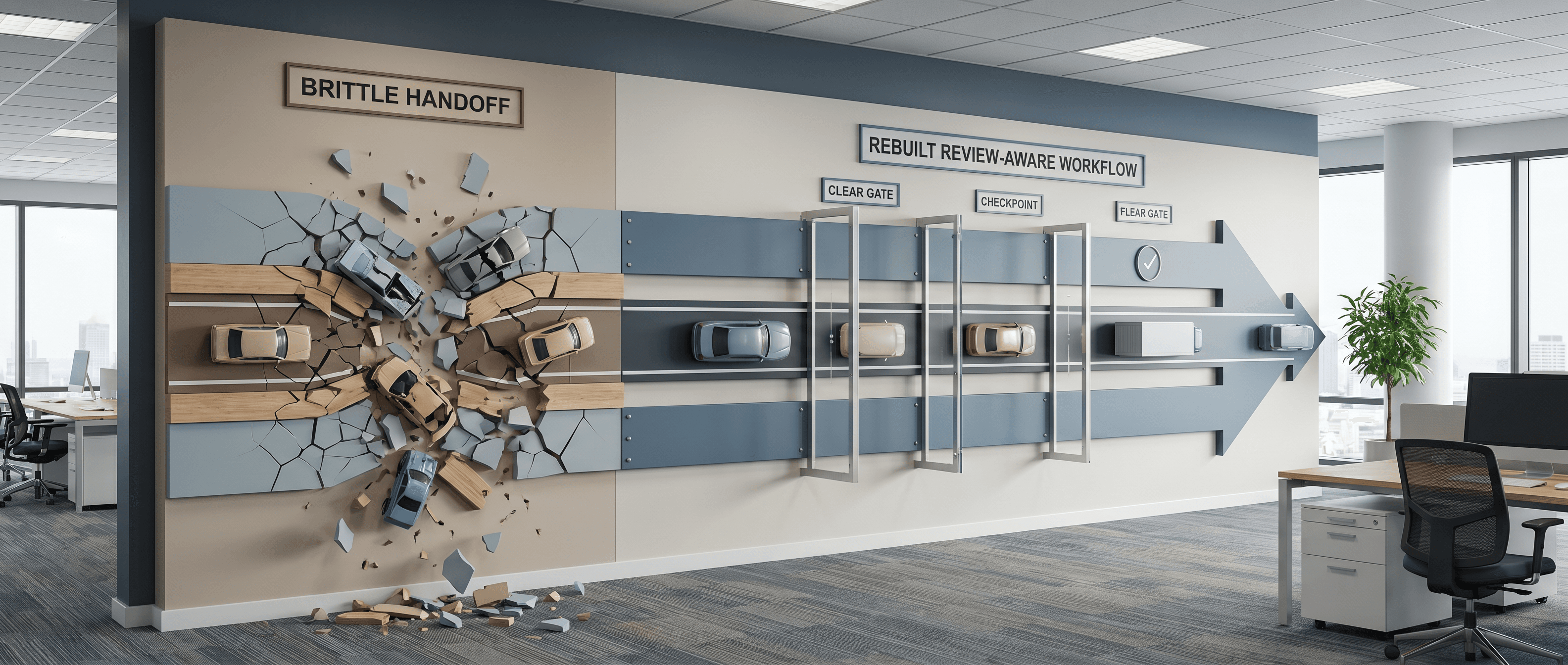
Teams often expect AI to clean up a messy process on the way in.
Usually it does not.
It exposes the mess faster.
That is why so many AI projects feel harder right after the demo phase. The model may be working well enough. The workflow underneath it is what starts to crack. Definitions do not match across teams. Approval steps exist in conversation but not in process. Records move between systems without a clear owner. Cleanup work appears, but nobody can say who owns it.
AI did not create those problems. It made them visible.
Speed reveals workflow debt
A manual process can hide a lot of sloppiness.
People patch gaps in real time. Someone DMs the approver. Someone fixes a field by hand. Someone notices a weird edge case and quietly routes around it. The workflow still feels functional because humans are compensating for what the process never made explicit.
Then AI enters the picture.
Now the system drafts faster, routes faster, classifies faster, and updates faster. The hidden gaps stop feeling small. If one approval rule is fuzzy, the workflow can repeat the same mistake at scale. If definitions differ between operations and finance, the mismatch shows up in live records instead of a private spreadsheet. If nobody owns cleanup, every bad run becomes shared confusion.
That is why workflow debt often looks manageable right until automation touches it.
The hard part is still the system around the model
Microsoft has been unusually direct about this in its 05/21/2026 and 06/02/2026 enterprise AI posts. The differentiator is not the model by itself. It is execution. It is the system around the model. That matches what operators keep seeing in real deployments.
Most teams do not fail because the model cannot produce useful output once. They fail because the surrounding process was never ready for faster execution. The workflow lacks one source of truth, one operating owner, one clean approval path, or one reliable way to reconstruct what happened after a bad run.
That is not a prompt problem.
It is an operations problem.
Governance gets urgent because the process was never as clean as it looked
AWS made the same point from a different angle in its 06/01/2026 AgentOps guidance. Governance, evaluation, and observability belong in the production stack from the start. That advice lands harder when you accept what AI projects are really doing. They are not just adding capability. They are stress-testing the process.
If the workflow was already ambiguous, governance becomes urgent fast.
Who can approve meaningful actions?
Who can stop the workflow when it starts creating bad records?
What evidence survives after a run?
Can anyone explain what happened without interviewing three people and checking two inboxes?
Those questions sound operational because they are operational. They become impossible to ignore once automation increases throughput.
Trust breaks where ownership and process are fuzzy
NIST's 05/18/2026 summary on AI security concerns is useful here because it frames trust and control as adoption barriers, not as theoretical objections. Teams slow down when authority boundaries are weak and failure modes are hard to explain.
In practice, that often starts earlier than people expect.
The buyer may say the AI output looks promising. The operator may say the workflow still feels risky. Both can be right at the same time. The model can be useful while the operating model is still too loose for production.
That is the moment when teams waste time if they keep shopping for a smarter model instead of fixing the workflow.
The common places workflow debt shows up first
The pattern is pretty consistent:
- Different teams describe the "same" process differently.
- Approval logic lives in Slack, email, or someone's memory instead of the workflow.
- The handoff between systems depends on a person noticing something weird.
- Cleanup after a wrong draft, wrong record, or wrong route has no named owner.
If AI makes one of those weak spots more visible, that is not a sign to abandon the project. It is a sign to stop pretending the process was production-ready before automation touched it.
A short readiness check before you automate the messy part
Before pushing AI deeper into a workflow, I would want clear answers to four questions:
- Can operations, finance, support, and leadership describe the current workflow the same way?
- Is there a named owner for cleanup when the workflow creates a bad record, wrong draft, or wrong action?
- Are approval points explicit in the process, or do they still live in side conversations?
- Can the team reconstruct what happened after a bad run without detective work?
If those answers are weak, the next step is not more sophistication. It is better workflow design.
The MTL view
AI creates leverage fastest when it lands on a process that already has clear ownership, explicit approvals, and clean handoffs.
When those things are missing, automation does not quietly solve them. It turns them into visible operating risk.
That is why workflow readiness matters so much. Before a team asks how much authority to give the system, it should ask whether the underlying process is stable enough to deserve that authority in the first place.
If your team has an AI workflow that looked good in the demo but feels chaotic the moment it touches real operations, that is usually the sign that the workflow needs redesign before the model needs replacement.
Book a discovery call here:
https://calendly.com/martintechlabs/discovery
FAQ
Why do AI projects make broken workflows more obvious?
Because AI increases speed and volume. Once a workflow starts drafting, routing, classifying, or updating records faster, unclear ownership and weak approvals show up much sooner.
Does a messy process mean a team should avoid AI automation?
Not always. It means the team should tighten ownership, approval points, and cleanup paths before the workflow gets broad authority in production.
What is AI workflow readiness?
AI workflow readiness is the team's ability to explain the process clearly, define who owns bad outcomes, place review where it matters, and reconstruct what happened after a run.
What should a team fix before automating a business workflow?
Fix the parts that create confusion under speed: mismatched definitions, side-channel approvals, fragmented tool handoffs, and unnamed cleanup ownership.