
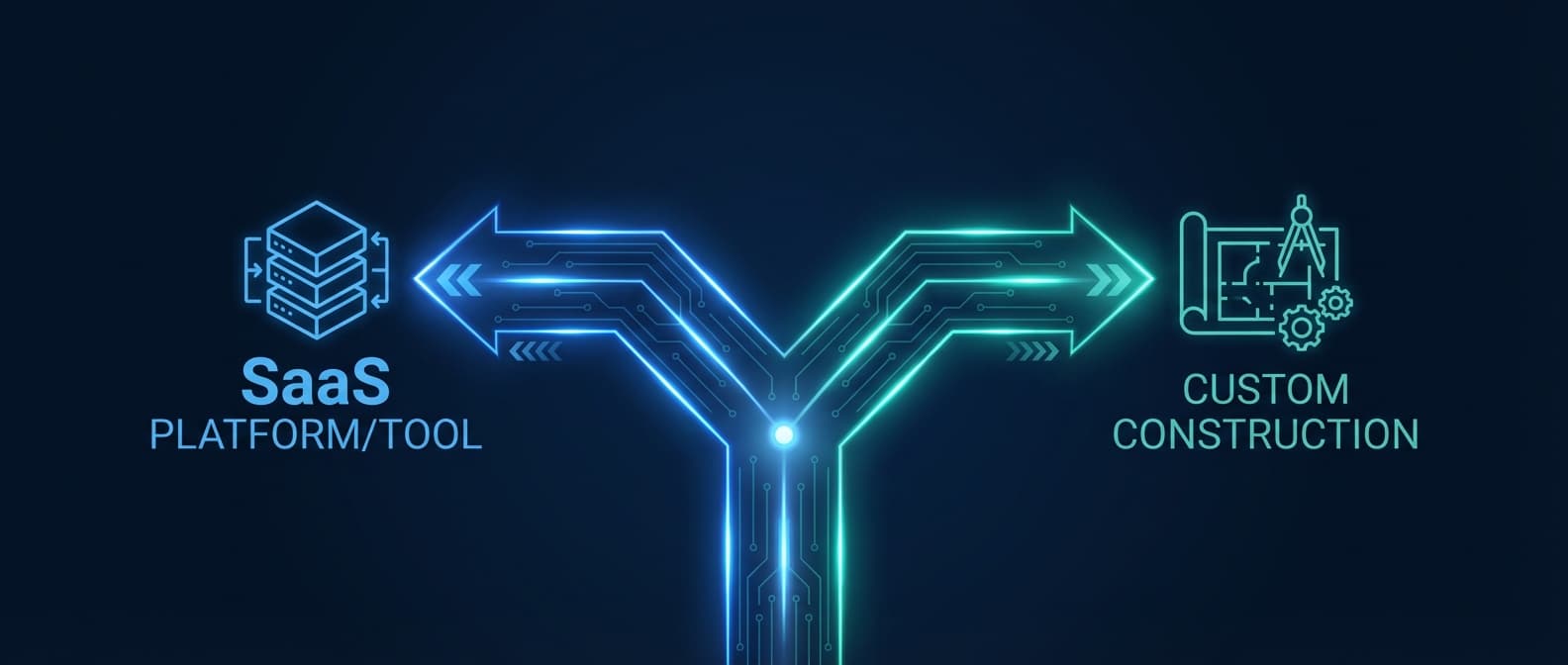
Most companies asking "should we build custom AI or use an existing tool?" are actually asking the wrong question.
The right question is: what problem are you actually trying to solve, and does it require something that exists?
That sounds obvious. Most decisions that get made badly are obvious in hindsight.
Why the off-the-shelf answer is usually right (and when it isn't)
The default answer for most AI use cases is: use what already exists. ChatGPT, Claude, Copilot, Notion AI, Zapier with AI actions. These tools work, they're cheap, and they're ready today.
If you need to summarize documents, draft emails, generate first-pass copy, or answer questions from your internal knowledge base — existing platforms cover most of that. The build/buy analysis for these cases is short. The marginal value of custom tooling is low. Use what's available.
The case for building something custom starts when you hit one of three conditions.
Your data is the moat. If the intelligence comes from proprietary data that no external vendor has access to — patient records, transaction history, customer behavior patterns, internal operations data — the platform tools can't give you the advantage you're after. They're trained on public data and fine-tuned on other companies' content. A model trained on your data and optimized for your use case is a different thing.
Your workflow is non-standard. Most AI tools are built around the most common workflows. If your process has unusual inputs, unusual outputs, or an integration requirement that doesn't fit a standard connector, you'll spend more time fighting the platform than building the feature. At some point, building a clean solution costs less than maintaining a collection of workarounds.
The economics of vendor dependency are bad. Subscription pricing increases 20 to 30 percent annually for a lot of SaaS tools. That's manageable when the subscription is small. When AI is central to your operation, a forced renewal negotiation or a pricing change becomes a business risk. Custom infrastructure you own doesn't have that problem.
The hidden cost of buying
The "just use an existing tool" argument usually relies on sticker price comparisons. One subscription looks much cheaper than a six-week build sprint.
The comparison breaks down when you add integration costs, the time your team spends configuring and maintaining platform connections, the features you give up because the platform doesn't support them, and the downstream cost of workarounds.
None of that shows up in the monthly invoice. It shows up as engineering time, product delays, and decisions made with incomplete information.
This doesn't mean you should always build. It means the cost comparison isn't as simple as it looks on a pricing page.
The build case requires honest answers to three questions
Before committing to a custom build, you need clear answers to three things:
What does success look like, and how do you measure it? Custom AI is only worth building if there's a meaningful, measurable outcome at the end. Productivity improvement, cost reduction, a new revenue line, a faster process. If you can't articulate the metric, the project will drift.
Do you have the data to train or fine-tune on? A custom model that's trained on weak, incomplete, or poorly labeled data will perform worse than a generic platform tool. The data question isn't just "do we have data." It's "do we have the right data, in usable form, in sufficient volume."
Who owns this after it ships? The build vs. buy question doesn't end at launch. Custom AI systems need monitoring, retraining as data drifts, model updates as better base models are released, and ongoing infrastructure. If there's no answer to who owns that, the system will degrade.
Most companies are in the grey zone
The honest description of where most companies land is: they have some use cases that are great candidates for custom AI, and most use cases that are fine with existing tools.
The smart approach isn't to pick a side. It's to run a structured audit of your workflows, find the one or two places where the custom build ROI is clear and the data is ready, build those, and use off-the-shelf tools for everything else.
That's the approach that produces working systems in weeks instead of six-month platform evaluations that end with a subscription purchase and a disappointed team.
How to start
If you're not sure which category you're in, a one-week AI automation audit will tell you. We review your workflows, your data, your team's capacity, and your actual business objectives, then give you a prioritized list: here's what to build, here's what to buy, and here's what isn't worth doing yet.
Most clients come out of the audit with a clearer picture than they expected. A few find out the answer is entirely off-the-shelf. Some find out they've been sitting on a custom-build opportunity for two years.
Either way, it's a week well spent.