
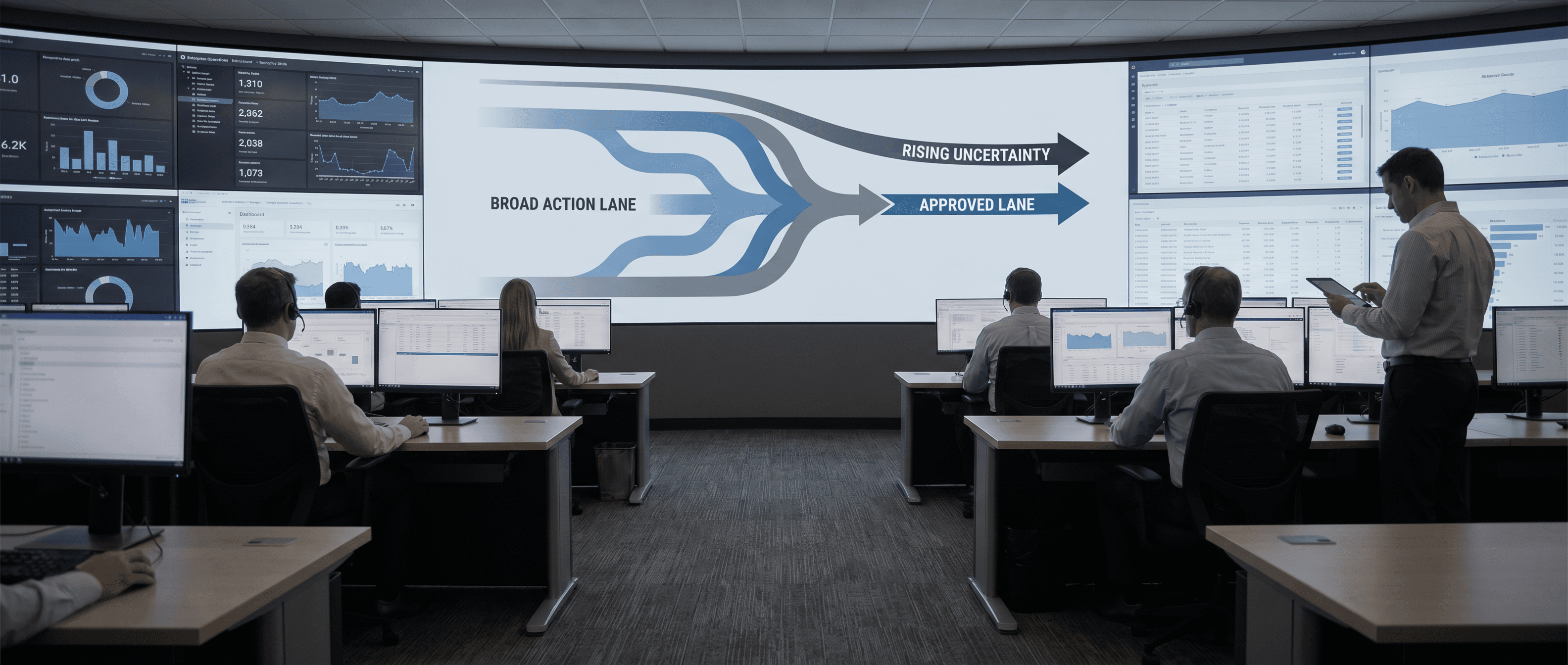
A lot of teams still think about AI guardrails as a fixed permissions problem.
Can the workflow read this system. Can it write to that one. Can it call this tool. Can it take that action.
Those are useful questions. They are not enough.
A production workflow should not have the same authority in every condition.
When the context is clean, the task is well-scoped, and the downside is low, the system can move faster.
When the input gets weird, the confidence drops, or the next action carries more business risk, the workflow should get smaller.
That is one of the clearest signs that the system is designed for production instead of for a demo.
Static permissions are only the starting point
A workflow can have the right baseline permissions and still behave badly.
It can keep the same write access when the source data looks incomplete. It can keep pushing forward when a document does not match the expected pattern. It can keep the same authority when a low-risk internal summary turns into a customer-facing action.
That is where a lot of AI systems get exposed.
The access model exists. The runtime judgment model does not.
I think that is the real gap behind a lot of "we approved the workflow, but we still do not trust it" conversations. The team gave the system a lane. They never designed what should make that lane narrower.
Good workflows reduce authority before they create cleanup
The goal is not to make every workflow timid.
The goal is to make authority conditional.
If the workflow is operating in a known path with known data and a low-risk action, maybe it can continue automatically.
If the workflow sees ambiguous input, conflicting signals, missing context, or an action with higher downside, it should stop pretending the situation is normal.
That is the moment where a strong system shifts modes.
It might move from write actions to read-only checks. It might withhold the final action and ask for approval. It might route the work into a review queue with the exact evidence an operator needs to decide what happens next.
That is not overengineering. That is how you keep one uncertain run from turning into hours of cleanup.
The market is making runtime control more visible
This is part of why the recent platform signals matter.
OpenAI's 06/17/2026 and 06/18/2026 updates made scheduled work, pause controls, and connected-app approval settings more visible in the normal product surface. That matters because it turns action-level control into a mainstream operating concern instead of a buried admin topic.
Anthropic has been moving in the same direction with connector permissions and custom-role controls. The pattern is consistent. Enterprise teams do not just want to know whether a workflow is enabled. They want to know what it can do, under which conditions, and where authority tightens before something expensive happens.
That is a better production question than "does the agent work?"
Runtime guardrails are a behavior design problem
AWS framed governance and security at the front of the AgentOps stack on 06/01/2026. Microsoft has kept repeating that the system around the model is what determines enterprise value.
I think both are pointing at the same practical truth.
A useful AI workflow is not just the model plus the tool call. It is the behavior model around uncertainty.
What happens when confidence drops.
What happens when the workflow reaches a higher-risk action.
What happens when a record looks incomplete, a document is inconsistent, or the output would affect a customer, a money movement, or a sensitive internal system.
If the answer is "the workflow keeps the same authority and hopes for the best," the guardrails are not real yet.
Four questions that expose weak runtime control
Before a workflow gets real authority, I would want four answers to be obvious.
- What exact signals should reduce the workflow's authority?
- Which actions get withheld or downgraded when those signals appear?
- When the workflow gets smaller, who reviews the next step?
- Can the team explain this behavior without opening five side documents and three admin panels?
If those answers are fuzzy, the workflow may have permissions.
It does not have good runtime guardrails yet.
The MTL view
Production AI trust is not just about what a workflow is allowed to do on its best day.
It is about what the workflow does when the situation stops being normal.
Good systems do not keep the same authority no matter what. They narrow scope. They ask for review. They stop before the uncertain run turns into downstream damage.
That is the pattern I would want in any workflow that touches live records, customer communications, financial operations, or document-heavy internal processes.
If your team is trying to decide where AI can take real authority, and what runtime guardrails should reduce that authority before a bad run gets expensive, book a discovery call here:
https://calendly.com/martintechlabs/discovery
FAQ
Why are static permissions not enough for a production AI workflow?
Because a live workflow should not keep the same authority in every condition. When confidence drops, context is incomplete, or downside rises, the workflow should narrow scope, ask for review, or stop.
What does it mean for an AI workflow to get smaller when uncertainty rises?
It means the workflow reduces its authority instead of pushing forward with the same power. It might switch from write actions to read-only checks, require approval, or route the work into a human review lane.
When should an AI workflow ask for approval instead of continuing automatically?
It should ask for approval when the action carries higher business risk, the input falls outside the normal pattern, the confidence signal weakens, or the workflow would otherwise create cleanup work that a person has to absorb later.
How can a team tell whether its AI workflow has real runtime guardrails?
If the team can explain what signals reduce the workflow's authority, what actions get withheld, and what review path takes over before the system creates damage, the guardrails are probably real.