
Your AI system passed testing. It's deployed. People are using it.
Is it working?
That question sounds simple. It isn't. Most teams that build AI systems have a good answer to "is it running" and a poor answer to "is it doing what we needed it to do." Those are different questions, and confusing them is how AI projects quietly fail after launch.
The gap between lab accuracy and production value
When you test an AI system before launch, you measure accuracy on a test set. You ask: does the model produce correct outputs for these inputs? If the number is good enough, you ship.
The problem is that test set accuracy is a proxy for the thing you actually want, which is business outcomes. And proxies stop being reliable when reality diverges from your test data.
Real users ask different questions than your test set anticipated. Real data has gaps, inconsistencies, and edge cases your evaluation didn't cover. Real workflows surface failure modes that clean test inputs don't trigger.
None of that shows up in your pre-launch accuracy scores. It shows up in production as outputs that are technically plausible but wrong for the context, user complaints that don't match your error rates, or a business metric that doesn't move despite the system running fine on paper.
The four things worth measuring
Not everything is worth tracking. The teams that get AI evaluation right focus on four categories.
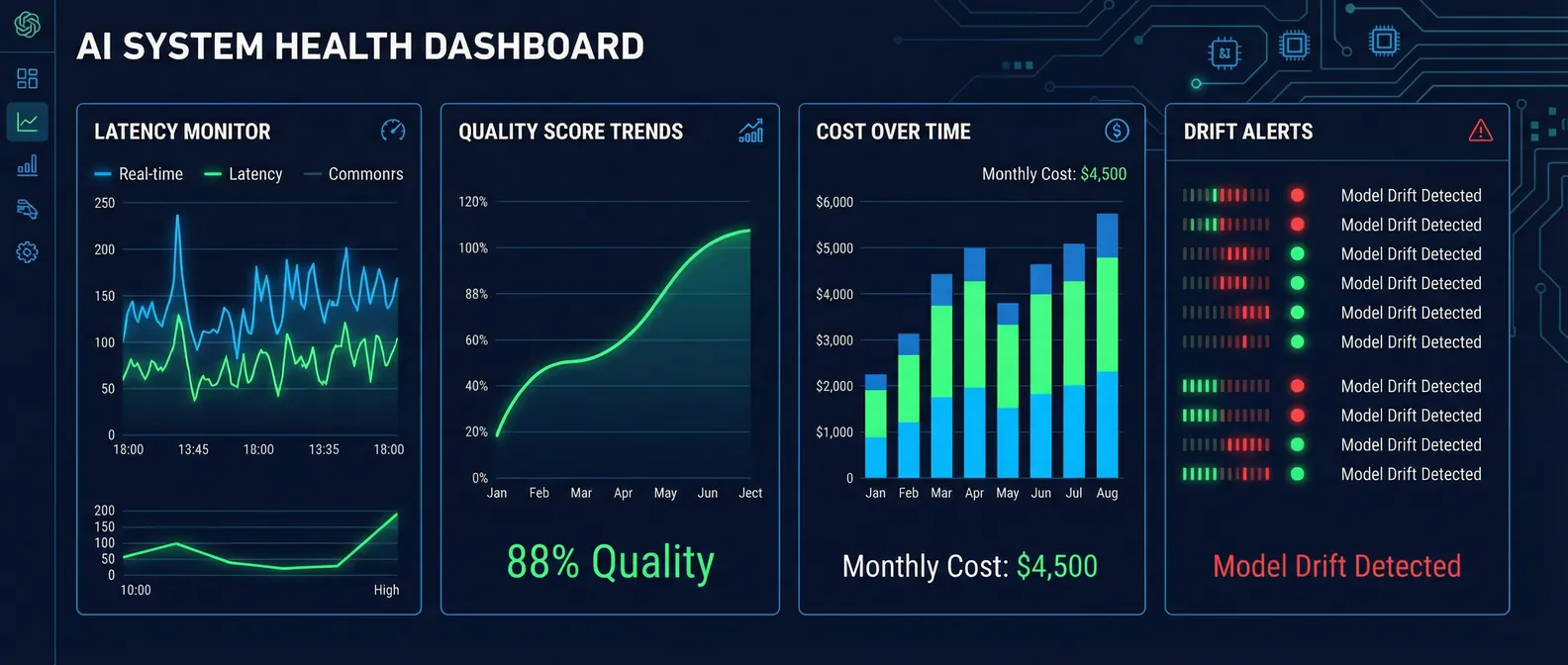
Output quality. Are the outputs the system produces actually good? This sounds obvious, but measuring it is harder than it sounds. For most AI systems, you can't check every output manually. The practical approach is a combination of automated evaluation — deterministic rules for things you can check programmatically, and an LLM-as-judge approach for things that require semantic understanding — and periodic human review of sampled outputs. The key is having a score that moves when quality changes, not just when the system breaks.
Business outcome alignment. The metric you actually care about. If you built an AI to reduce support ticket volume, does support ticket volume go down? If you built an agent to speed up document review, is review time faster? Technical metrics and business metrics often diverge. When they do, trust the business metric. It's telling you something the technical stack doesn't see.
Cost per outcome. AI systems have real operating costs: inference compute, API calls, storage, human review time. Tracking cost-per-output tells you whether the system is becoming more or less efficient over time. It also catches runaway cost patterns early, before a surprise at the end of the month.
Drift. The world changes. The data distribution your model was built on today won't match the distribution it encounters in six months. Drift detection means tracking whether the statistical properties of inputs and outputs are shifting over time. A gradual shift in input characteristics often precedes a quality degradation by weeks. Catching drift early lets you retrain proactively instead of reactively.
The governance gap most teams ignore
Most AI monitoring setups cover technical metrics: latency, error rates, uptime. Fewer cover quality. Even fewer have a clear answer to: who is responsible when the system produces a bad output that causes a real problem?
That's the governance gap. It's not an edge case. At sufficient scale, AI systems will produce outputs that cause harm — to a customer relationship, a business decision, or a compliance requirement. The question isn't whether it will happen. It's whether you have the mechanisms to detect it, stop it, and fix it.
The practical version of this is: every AI system in production should have a human oversight point for high-stakes decisions, an audit trail that logs what the system did and why, and a kill switch that lets you halt or constrain the system without a full deployment rollback.
None of this is complicated to build. It's mostly not built because teams are focused on features and performance rather than failure modes.
When to retrain, tune, or rebuild
Monitoring tells you something is wrong. It doesn't always tell you what to do about it.
A rough framework:
Retrain when the issue is drift in the underlying data distribution. The model architecture and training approach are sound, but the world has changed enough that the model's weights are stale. Retraining on updated data with the same approach usually fixes this.
Fine-tune when the issue is a specific category of failure on a well-defined class of inputs. The model works broadly but handles certain cases poorly. Fine-tuning on examples of those cases — with correct outputs — can improve performance without a full retrain.
Rebuild when the architecture was wrong to begin with. If you're finding that the fundamental structure of how the system works doesn't fit the problem, tuning and retraining won't help. You need to start from a better design. This is less common but worth recognizing early. The signal is usually that every fix creates a new problem.
What good looks like
A production AI system that's actually working has a short answer to each of these questions:
- What is the quality score today, and how does that compare to last month?
- Which business outcome is this system supposed to drive, and is that metric improving?
- What does the system cost per output, and is that trending in the right direction?
- Has there been any significant drift in input distribution in the last 30 days?
- If the system produced a bad output right now, who would know, and how quickly?
If you can answer all of those, you're in good shape. If more than two of them are "I don't know," the system is running but not managed.
The difference matters more than most teams realize. An unmanaged AI system in production isn't a solved problem. It's a debt that compounds.
If you're building an AI system and want to make sure you're setting up the right evaluation and monitoring from the start, that's exactly the kind of thing we cover in an AI Automation Audit. One week, clear recommendations on what to build and how to make sure it keeps working after you ship it. Book a discovery call to talk through what you're building.