
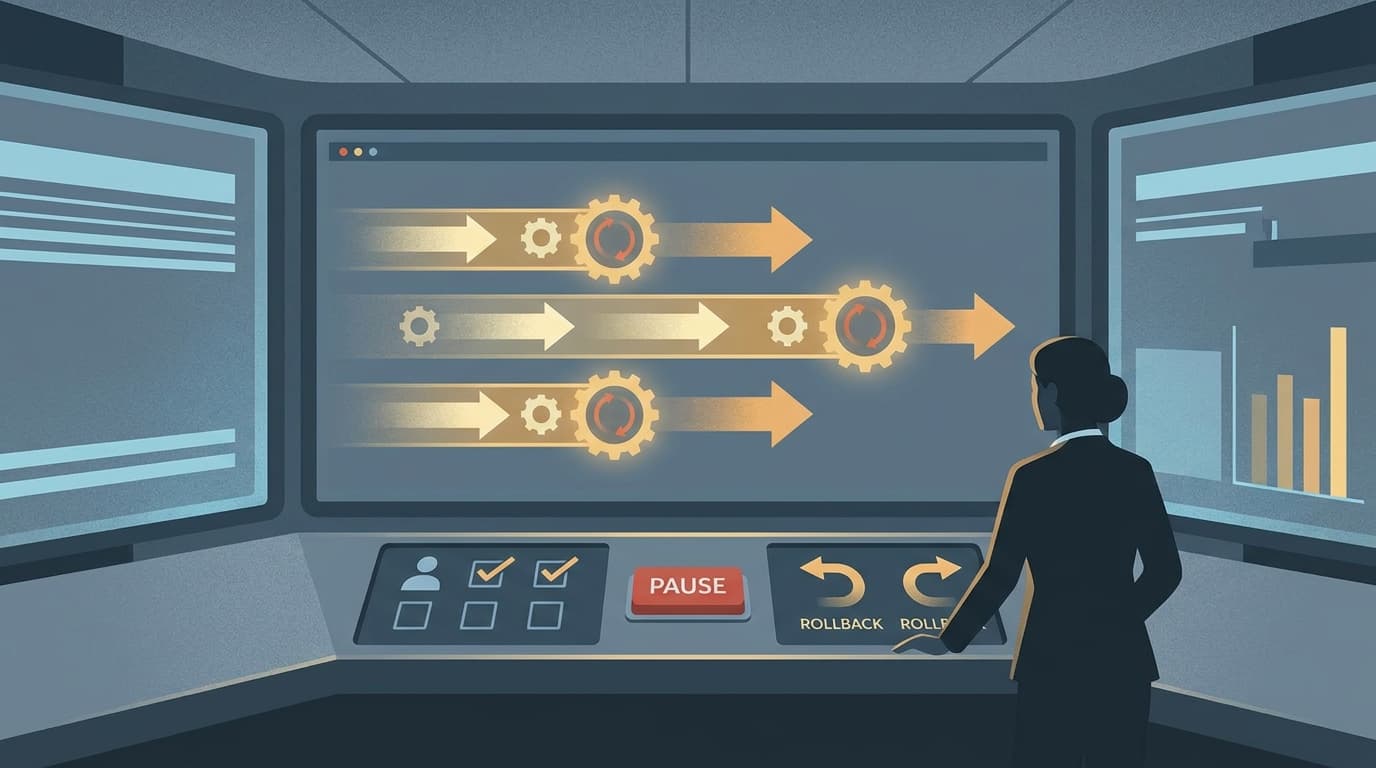
Most teams do not get in trouble with AI because the model is weak.
They get in trouble because the rollout is loose.
The first version touches a live workflow too early. Permissions are broader than they need to be. Nobody writes down when the system should stop and ask for help. A tool call fails halfway through a run, and the team realizes there is no clean handoff to a human. Then the project stalls. Not because AI cannot help, but because operations teams stop trusting the setup.
That is the part worth fixing.
The strongest public signals from the last month all point the same way. OpenAI has been talking about enterprise teams managing agents that execute work inside real workflows. Anthropic has been pushing deployment controls, spend limits, connector governance, and telemetry into the rollout conversation. NIST is putting more attention on identity, authorization, and traceability for agents. The market is getting more operational. That is healthy.
If you are trying to move an AI workflow from pilot to production, I would keep the rollout simple and a little conservative.
Start with one narrow workflow
The fastest way to lose momentum is to launch an AI system with a vague charter.
"Automate support." "Handle sales ops." "Review back-office work."
Those are not rollout scopes. They are ambitions.
A workable first rollout owns one painful job with a visible input, a visible output, and a system of record in the middle. Good examples:
- Review inbound leads against a fixed rubric and create internal follow-up tasks
- Classify incoming documents, extract fields, and route exceptions for review
- Draft account updates from product usage signals for a human to approve
The test is simple. Can someone explain what counts as done in one sentence? If not, the workflow is still too wide.
Write stop rules before you write launch copy
This is where a lot of AI projects still cut corners.
The team spends weeks on prompts, tool calls, and evaluation, then leaves the stop rules implied. In production, implied rules turn into operator anxiety. People stop trusting the system because they cannot tell where autonomy ends.
Your first rollout should include explicit stop rules such as:
- Missing or conflicting data
- Low-confidence classifications
- Requests that affect money, discounts, refunds, or billing
- Actions that change permissions or customer-visible records
- Any output that creates a commitment on behalf of the company
The goal is not to make the workflow timid. The goal is to make it legible. A good production system knows when to continue and when to pause.
Put approvals where the business risk actually is
Not every AI action needs a human in the middle. If it did, you would not get much leverage.
What matters is matching approvals to risk.
A low-risk action might be tagging a ticket, drafting an internal note, or creating a task in a queue. A higher-risk action might be updating a contract status, issuing a customer-facing response, changing ownership in the CRM, or triggering a financial workflow.
That is where teams should be specific. Do not say "the agent can use the CRM." Break it into verbs:
- Read records
- Create draft updates
- Add internal notes
- Change status
- Reassign ownership
- Trigger downstream actions
Those are very different powers. Treat them that way.
Keep a readable trace for every run
If an operator asks, "Why did it do that?" the answer cannot live inside a pile of raw logs.
Every production workflow needs a readable trace that shows:
- What kicked off the run
- What records or documents were inspected
- Which tools were called
- What decision the system proposed
- What changed in the source system
- Whether a human approved, rejected, or edited the action
- Where the workflow stopped
This matters more than teams expect. Traceability is becoming part of the buying conversation because businesses want to know they can review, defend, and improve the system after launch. That is not compliance theater. It is basic operating discipline.
Make rollback boring
Rollback should feel almost disappointing.
No drama. No heroics. No long war room.
If the workflow starts behaving badly, the team should know exactly how to pause it, what actions can be reversed, which queue catches the unfinished work, and who owns cleanup. If those answers do not exist before launch, the rollout is not ready.
For most teams, the first rollback plan can stay simple:
- Turn off autonomous writes.
- Route new cases into a manual review queue.
- Audit the last batch of system changes.
- Re-run only the cases you can verify safely.
That is enough to reduce a lot of anxiety. People trust systems more when they know they can unwind them cleanly.
Measure the rollout like an operations project
A surprising number of AI rollouts still get measured like demos.
The team celebrates that the model completed a task. That is not the bar. The bar is whether the workflow improved the business without creating new operational mess.
For an early rollout, I would track:
- Volume handled
- Percentage of cases that hit stop rules
- Human review load
- Time saved per completed unit
- Error rate on the outputs that actually matter downstream
- Time to detect and recover from failures
Those metrics tell you whether autonomy is earning trust. They also tell you whether the next step should be more scope, tighter rules, or a smaller target.
What the recent market signals are really saying
The useful lesson from this month's enterprise AI updates is not that every company should rush to deploy more agents.
It is that the conversation has moved past "can the model do the task?" and toward "can the business operate this safely and repeatably?" That is a better question.
OpenAI's recent enterprise and agent infrastructure updates, Anthropic's deployment guidance, NIST's standards work, and the broader push toward runtime controls and identity boundaries all point in the same direction. Production AI is becoming an operations discipline. Teams that treat rollout as workflow design plus controls will move faster than teams that treat it as a prompt experiment with extra enthusiasm.
A practical rollout checklist
Before you launch an AI workflow into live operations, make sure you can answer these questions clearly:
- What exact job does the workflow own?
- What system is the source of truth?
- What can it read?
- What can it write?
- Which actions require approval?
- What conditions force escalation?
- What does a reviewer see when something looks wrong?
- How do you pause it?
- How do you roll back a bad change?
- Who owns the workflow after launch?
If those answers are fuzzy, slow down. A narrower rollout usually ships faster than a broad one because the trust problem is smaller.
That is still the pattern I see most often. The teams that get to production are not always the ones with the flashiest demos. They are the ones that define the job, scope the permissions, write the stop rules, and keep rollback simple.
If you are planning an AI rollout and want a second set of eyes on the workflow, controls, and handoff design, book a discovery call.