
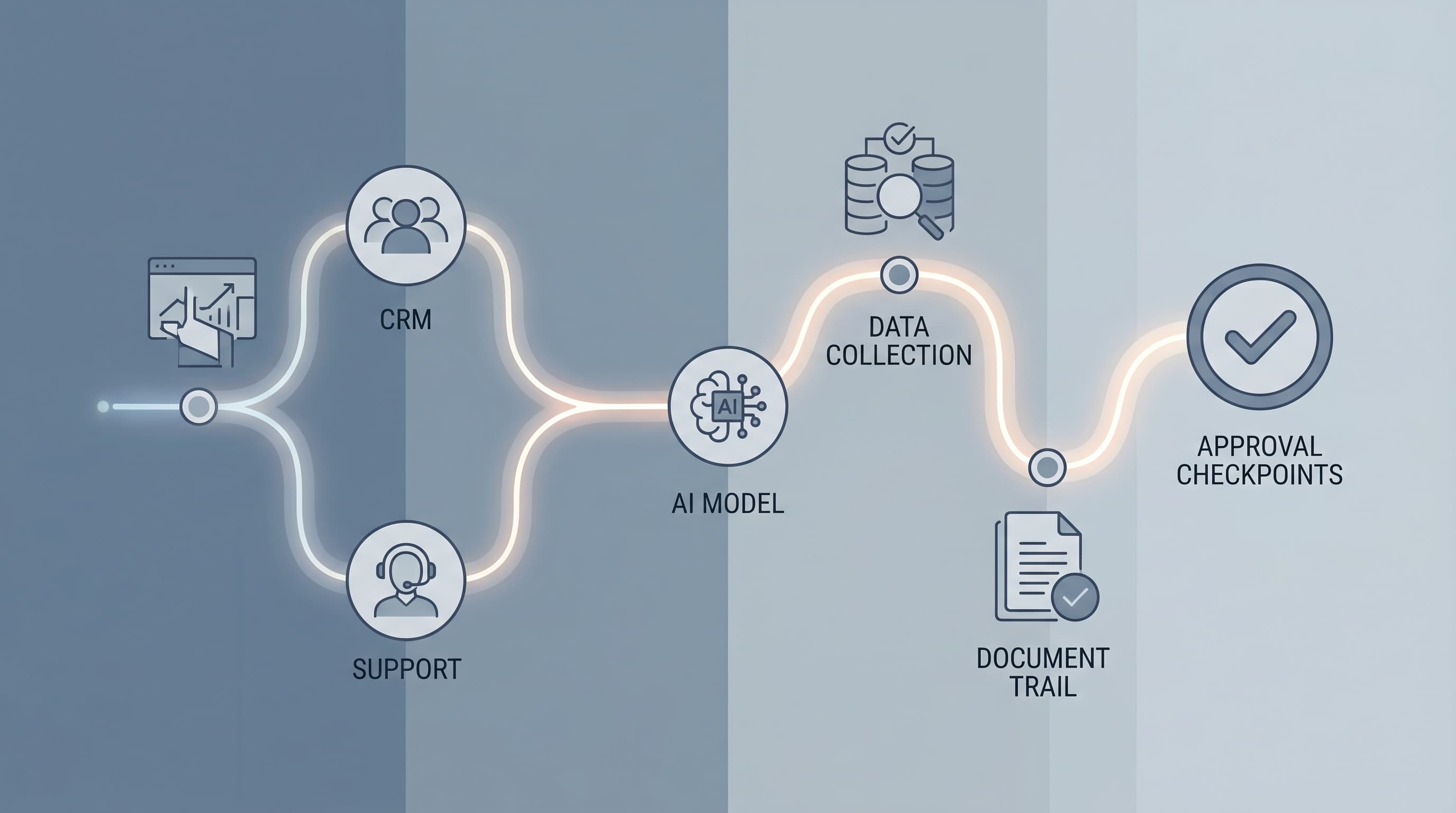
There is a simple test I keep coming back to with AI workflows.
If the system touches live business data, can you show what it touched?
Not in theory. Not in a sales diagram. In the actual run.
What triggered it. What records it read. What sources shaped the output. What it changed, routed, or suggested. Whether a human reviewed it. What happened next.
If that evidence is missing, I do not think you have a production workflow yet. You have a useful demo, maybe even a promising one, but there is still a trust gap sitting right in the middle of the rollout.
A good answer is not enough
This is where a lot of teams get fooled.
The workflow produces a decent result in a test environment. The summary looks right. The extraction looks clean. The recommendation sounds reasonable. Everybody starts focusing on model quality because that is the most visible part of the system.
Then the workflow moves closer to live operations and the harder questions show up fast.
Which customer record did it use?
Did it pull from one repository or three?
Did it read the current version or a stale copy?
Did it update the CRM directly, or only draft a suggestion?
Who reviewed the output before it moved downstream?
Can anyone reconstruct the run a week later without guesswork?
Those are not compliance-only questions. They are operating questions. If the team cannot answer them quickly, confidence drops even when the model output still looks good.
The market is moving toward evidence, not just capability
The strongest enterprise AI signals this month all pushed in the same direction.
AWS added an AgentCore-powered reasoning step to Step Functions on 06/03/2026 and centered the message on execution history, human approval before critical actions, model and tool overrides, token visibility, and traceable runs.
Microsoft's current Purview guidance goes even more directly at the audit layer. The useful shift is not just "AI is logged." It is that the audit story increasingly includes resource-level evidence about what was accessed and which policies applied.
OpenAI's recent enterprise updates point the same way from a different angle. Publishing controls, scoped connector sync, and workspace governance all push buyers toward the same question. What can this workflow touch, and how can we prove it stayed inside the right boundary?
That matters because enterprise buyers are getting trained to ask for proof. "Trust us" is not a production model.
Why this becomes the real blocker
Most production AI projects do not stall because nobody believes the model can do the task.
They stall because the team cannot get comfortable with what happens around the task.
A support triage workflow might read account history, route tickets, and suggest urgency. A finance review workflow might classify invoices and flag mismatches. A document-processing workflow might extract terms and push them into a system of record.
In every one of those cases, the business eventually asks the same thing.
Show me what the workflow saw.
Show me why it made that move.
Show me what happened after the recommendation.
Show me how we would catch a bad run.
That is the real move from experiment to production. Once the workflow starts shaping business activity, evidence stops being optional.
"Human in the loop" is not the same as a usable audit trail
I still see teams hide behind vague review language.
"There is always a human in the loop."
Fine. But where?
What do they actually see before they approve?
Can they tell which sources informed the output?
Can they see whether the workflow touched the wrong record set?
Does the review step create evidence that survives the run, or does it disappear into chat, email, or memory?
A human approval step can be useful. It is not a replacement for traceability.
If the reviewer cannot inspect the right context, the approval is weak. If nobody can reconstruct the decision later, the workflow is still weak. Review without evidence is mostly theater.
What I would want to see in a production run
The exact schema depends on the workflow, but the minimum bar is not mysterious.
I would want to see:
- what triggered the run
- which systems and records were accessed
- which version of the source material was used when that matters
- what output the workflow produced
- whether the workflow only drafted, routed, recommended, or acted
- who reviewed or approved the result
- what downstream action happened next
- what exceptions or stop conditions fired
That sounds basic because it is basic. The problem is not that teams do not know this matters. The problem is that many rollouts still treat evidence as cleanup work for later.
Later usually arrives right after the first bad run, the first awkward customer question, or the first internal argument about whether the workflow can stay on.
This is especially true when the workflow crosses systems
Single-surface copilots are easier to tolerate because the blast radius is smaller.
The risk changes when the workflow crosses boundaries. Read from one system, write to another, notify a third, and then queue work for a human reviewer. That is where missing evidence turns into real operating pain.
Now the team needs to know whether the workflow read the wrong segment, pushed the wrong recommendation, or skipped a review path because of bad context upstream.
Without run evidence, every problem turns into manual forensics.
That is expensive. It is slow. It also erodes trust far faster than a plainly visible model mistake.
The practical standard
I think teams should use a blunt production standard.
If the workflow can touch live data, route business work, or shape a downstream decision, it needs a visible run history that another person can inspect after the fact.
Not just logs for engineers.
Usable evidence for the people who own the workflow, review the output, manage the risk, and defend the rollout internally.
That does not mean every workflow needs an enormous governance stack on day one. It does mean the team should stop pretending a black-box run is acceptable just because the demo looked smart.
The useful next step
If your team is stuck in the gap between "the workflow seems to work" and "we are not comfortable turning it on," start with the evidence layer.
Ask what each run needs to prove.
Ask what the reviewer needs to see.
Ask what data the workflow is allowed to touch.
Ask how a bad run would be reconstructed without panic.
That conversation usually gets you closer to production than another round of prompt tweaks.
If you are trying to design an AI workflow your team can actually trust in production, book a discovery call.
FAQ
What does an AI workflow need to show before it counts as production-ready?
It should show what triggered the run, what data it touched, what output it produced, what actions were taken, and who reviewed or approved the result when review was required.
Why is data-touch evidence so important in production AI?
Because once a workflow reads customer records, finance data, support history, or internal documents, the main risk is no longer the demo quality by itself. The real question is whether the team can prove what happened and contain problems when something changes.
Is a human approval step enough to make an AI workflow safe?
No. Approval helps, but it is only one control. The workflow also needs scoped access, visible run evidence, clear stop conditions, and an owner for exceptions after launch.
What are examples of workflows that need strong audit evidence?
Common examples include CRM updates, support triage, finance review queues, contract extraction, patient intake processing, and any workflow that routes or changes records inside a live system.