
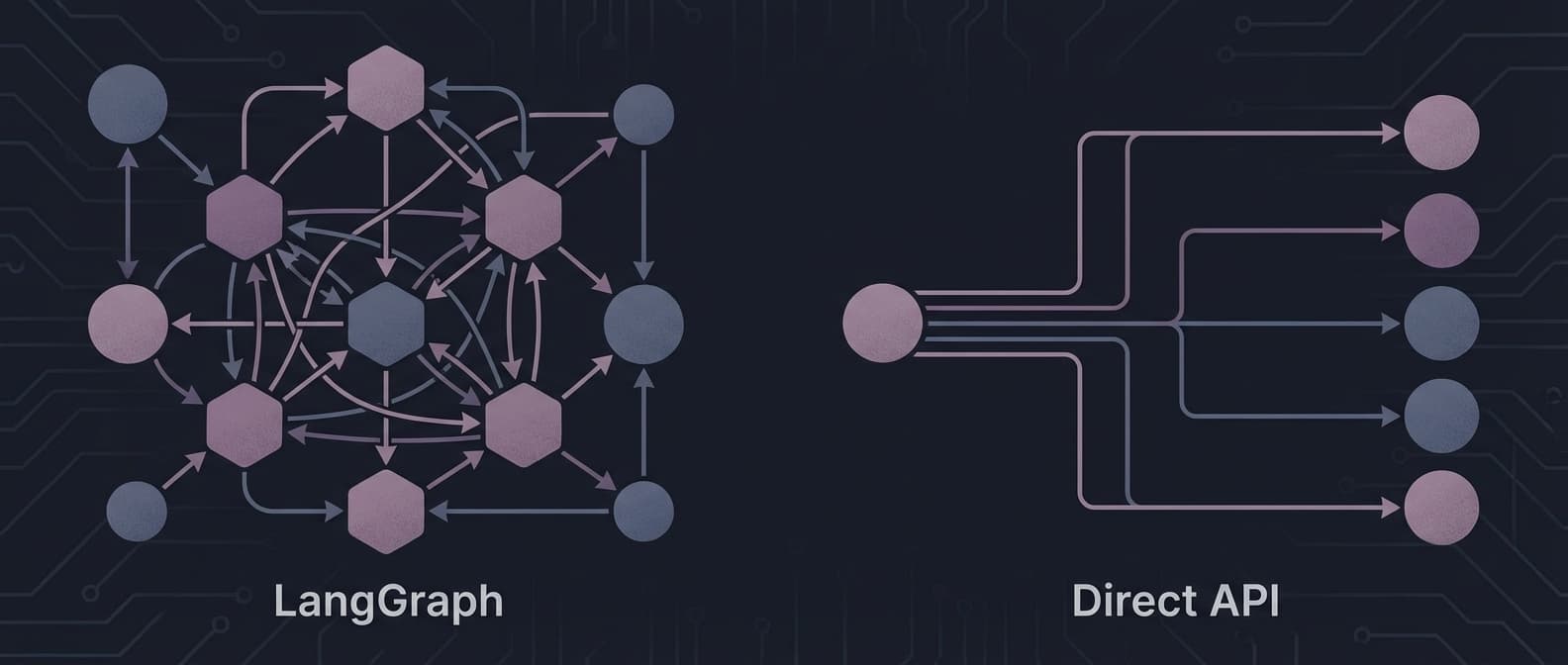
LangGraph vs. direct API calls for multi-agent systems: when the abstraction helps
Multi-agent AI systems — where multiple models or AI components work together on a task — have moved from research curiosity to legitimate production pattern over the past year. With that shift has come a proliferation of frameworks promising to make orchestration easier.
LangGraph is one of the more serious options. We've used it in production and we've built equivalent systems without it. Here's our honest take on where the abstraction earns its keep and where it becomes a liability.
What LangGraph actually provides
LangGraph is a framework built on top of LangChain for building stateful, multi-step AI applications. Its core abstraction is a directed graph where nodes are functions (often LLM calls or tool invocations) and edges define how execution flows between them.
What this gets you:
Explicit state management. LangGraph maintains a typed state object that flows through the graph. Each node reads from and writes to that state. This makes the data that's accumulating across steps visible and manageable, rather than buried in a growing context window.
Conditional routing. Edges can be conditional — the graph can branch based on the content of the current state. This makes it straightforward to express "if the extraction step produced a confidence below threshold, route to human review; otherwise, continue." Decision logic lives in the graph structure rather than scattered through code.
Built-in persistence and checkpointing. LangGraph integrates with various persistence backends to checkpoint state, which enables resuming interrupted workflows, human-in-the-loop approval steps, and long-running async processes.
Streaming and observability. Events are emitted at each step, which makes streaming partial results to a UI and observing execution easier than with custom implementations.
Where it earns its cost
For genuinely complex multi-agent workflows — ones that involve branching logic, long-running state, human approval steps, or multiple specialized sub-agents — LangGraph's abstractions do meaningful work. The alternative is building all of that yourself: state management, routing logic, checkpointing, error recovery.
The clearest use case: a workflow where you need to maintain state across many steps, some of which might fail and need to be retried, some of which need human approval before continuing, and where the execution path is conditional on intermediate results. This is where the framework's primitives pay for themselves.
We've also found LangGraph useful for prototyping complex architectures quickly. The graph structure makes the flow of a multi-agent system easier to reason about and communicate than equivalent code spread across functions and classes.
Where the abstraction costs you
The abstraction leaks. LangGraph is built on LangChain, which means you're inheriting its abstractions and their limitations. When something breaks or behaves unexpectedly, you're debugging through multiple layers. For teams that want to understand exactly what's happening at each step, this opacity is a real cost.
The overhead is real. For simple sequential workflows — call model A, parse result, call model B, return output — LangGraph adds setup and runtime overhead without providing meaningful benefits. Two function calls and a dictionary don't need a graph.
State management gets complex. The typed state object that flows through the graph is powerful, but it becomes unwieldy in systems with complex state requirements. You end up writing a lot of state transformation code, and the graph structure that was supposed to make things clearer can become hard to follow as the system grows.
Version stability has been a concern. LangChain and LangGraph have had significant API changes across versions. Systems built on earlier versions have required meaningful refactoring when upgrading. This is less severe than it was 18 months ago, but it's worth knowing if you're building something you'll maintain for years.
The direct API approach
Building multi-agent orchestration without a framework means writing the routing logic, state management, and execution control yourself. For simple systems, this is usually the right call — it's less code, more transparent, and easier to debug.
A system where the flow is linear, the state is simple, and the execution model is synchronous rarely benefits from a framework. A direct implementation with clear function signatures, explicit state passing, and straightforward error handling is faster to build, easier to test, and more maintainable.
For more complex systems, the question becomes whether the framework's abstractions match your specific complexity. If your system's complexity is primarily in the routing logic and state management that LangGraph handles well, the framework helps. If your complexity is elsewhere — in the quality of individual model calls, in the data transformations between steps, in integration with external systems — the framework adds overhead without addressing your actual hard problems.
How we decide
The decision point we use in practice: would this system benefit from explicit graph-based state management and conditional routing, or is the execution flow simple enough that those abstractions add complexity rather than reduce it?
For agent systems with three or more specialized components, conditional routing based on intermediate results, or human-in-the-loop requirements — LangGraph is worth evaluating.
For sequential pipelines, simple state, and linear execution — direct API calls, cleaner code, better debuggability.
The middle ground: prototype in LangGraph to validate the architecture, then evaluate whether the complexity of the actual system justifies keeping it. Sometimes the prototype reveals that the system is simpler than expected and the framework is unnecessary. Sometimes it reveals genuine complexity where the framework helps.
If you're evaluating multi-agent architectures for a specific project and want a second opinion on the right approach, book a discovery call.