
The market is getting more comfortable with scheduled AI work.
That part is not controversial anymore.
Teams can now point to polished product surfaces for recurring tasks, scheduled runs, admin controls, and usage limits. The tooling is getting easier to buy. It is getting easier to demo. It is getting easier to turn on.
What is still easy to miss is the operating question underneath it.
If an AI workflow wakes up every morning and touches real work, who owns that run?
Who can stop it?
What keeps it from repeating the same mistake five times before anyone notices?
That is why I think scheduled AI work needs three things before it deserves production trust.
It needs an operator. It needs a limit. It needs a control surface.
A schedule is not the same thing as an operating model
Plenty of teams still treat these as the same decision.
They prove the workflow can run at 8:00 AM. They see the right output once or twice. They connect it to a real system. Then they assume the hard part is done.
It usually is not.
Scheduling answers one narrow question. When should this workflow wake up?
Production readiness answers the harder set of questions. Who owns it. What can it read. What can it write. What can it spend. What happens if upstream data changes. What happens if the output is wrong. What happens if the workflow should not run today at all.
Those are operating questions, not prompt questions.
The first requirement is an operator
Every recurring workflow needs a named operator.
Not a vague team. Not "engineering." Not "ops and someone from product if needed."
A named operator.
That does not mean the operator does every step by hand. It means there is a person or role with clear authority to pause the run, inspect the state, decide whether the output is acceptable, and own the cleanup path when the workflow misfires.
This matters because recurring AI work tends to drift into gray zones.
A support triage flow starts by drafting internal summaries. Then someone lets it classify urgency. Then it begins suggesting replies. Then it gets connected to the help desk. Then one busy week later it is moving customer work faster than the team can really inspect it.
The same thing happens in CRM enrichment, document operations, internal finance prep, and approval queues. The workflow picks up authority in small pieces until nobody can say exactly who is supposed to step in when it gets weird.
That is not a tooling problem. It is an ownership problem.
The second requirement is a limit
The scheduled workflow also needs a clear limit.
Actually, it usually needs several.
It needs a scope limit so it only touches the systems and records required for the job.
It needs an action limit so it does not silently move from drafting work to taking irreversible actions.
It needs a usage or budget limit so it cannot keep burning tokens, tools, or API calls without anyone noticing.
It often needs a frequency limit too. Just because a workflow can run every hour does not mean it should.
This is where a lot of AI automation gets overtrusted. The team sees a successful run and assumes more frequency or more authority is the natural next step.
Sometimes the right next step is the opposite.
Keep the workflow narrow. Cap the run. Limit the write path. Require review before it posts back into the source system. Make it earn more authority later.
That usually feels slower at first. In practice it is what keeps the cleanup cost from exploding.
The third requirement is a control surface
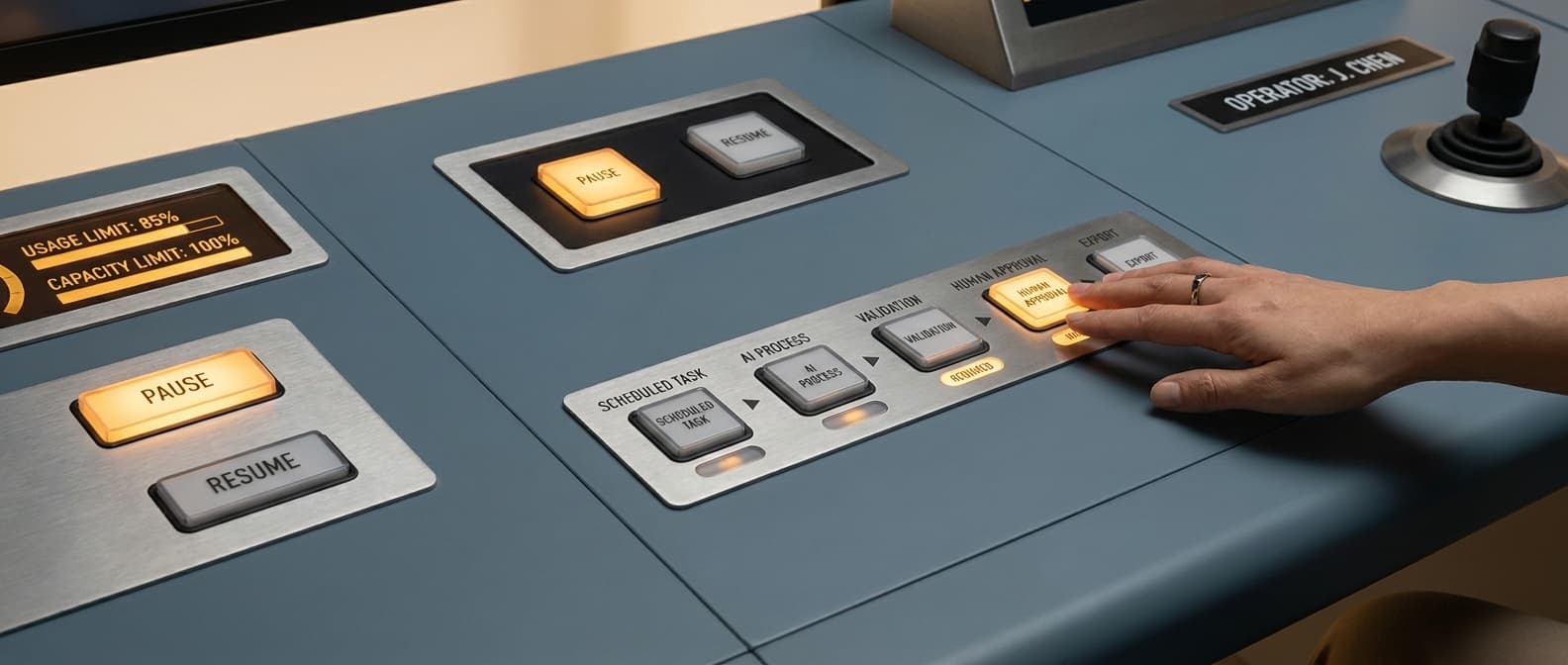
If the workflow is scheduled, there has to be a visible place to manage it.
I do not just mean a hidden cron job or a config file buried in a repo.
I mean a real control surface where an operator can see the next run, pause it, resume it, edit it, inspect what happened, and understand whether the workflow is inside its intended limits.
The big platform direction is moving this way for a reason. The market is being taught that recurring AI work should be visible and governable, not just automatic.
That shift matters because most bad recurring workflows do not fail in one dramatic moment.
They fail through repetition.
The same wrong classification gets applied across a queue. The same document rule gets misread over and over. The same CRM record gets enriched with low-quality data every morning. The same finance-adjacent job keeps creating messy exceptions that nobody fully owns.
When the control surface is weak, teams notice the damage late.
When the control surface is strong, teams can stop the pattern before it becomes operational debt.
Review is not anti-automation
One of the worst habits in AI projects is treating human review like a sign that the automation is not mature enough.
I think that framing is backwards.
In a lot of recurring workflows, review is part of the product.
If the workflow touches customer communications, money movement, compliance-sensitive documents, or system-of-record updates, a review step is not a failure. It is part of the architecture.
The real question is whether the review step has enough context to be useful.
Can the reviewer see what changed. Can they see what source material the workflow used. Can they reject the action cleanly. Can they stop the next run if the pattern looks unsafe.
If not, the workflow is not really reviewed. It is just delayed.
The practical test
When I look at a scheduled AI workflow, I usually want five boring answers:
Who owns this run?
What can it touch today?
What are the hard limits on actions, spend, and frequency?
Where do I pause it?
What evidence will I have after a bad run?
If those answers are fuzzy, the workflow may still be useful. It just is not ready for broad production trust yet.
That is the part a lot of teams learn too late. A recurring AI workflow is not dangerous because it runs on a schedule. It is dangerous when it can keep running without a clear owner, without visible limits, and without an obvious place to intervene.
That is why I keep coming back to the same point.
Scheduled AI work needs an operator, a limit, and a control surface before it deserves real authority.
If your team is trying to move an AI workflow from demo mode into recurring production use, and you need to decide where the limits, review points, and ownership boundaries belong, book a discovery call here:
https://calendly.com/martintechlabs/discovery
FAQ
What makes a scheduled AI workflow safe enough for production?
It needs more than a timer. A production-ready scheduled workflow needs a named operator, clear action and spend limits, visible run history, and a way to pause or review work before a bad run spreads.
Why is scheduling an AI task not the same as controlling it?
Because scheduling only answers when the workflow runs. Control answers who owns it, what it can touch, what stops it, and what evidence survives after it acts.
What should a team limit before a recurring AI workflow touches live systems?
The team should limit connected-system scope, write authority, run frequency, usage or budget, and downstream actions that can trigger more work without review.
When should a recurring AI workflow pause for human review?
It should pause when confidence drops, exceptions pile up, customer-facing actions are involved, or a bad output would create real cleanup work in operations, finance, support, or compliance.