
Most teams ask the wrong first question.
They ask what model to use. Or whether they need one agent or five. Or which tool has the slickest demo.
The better question is simpler.
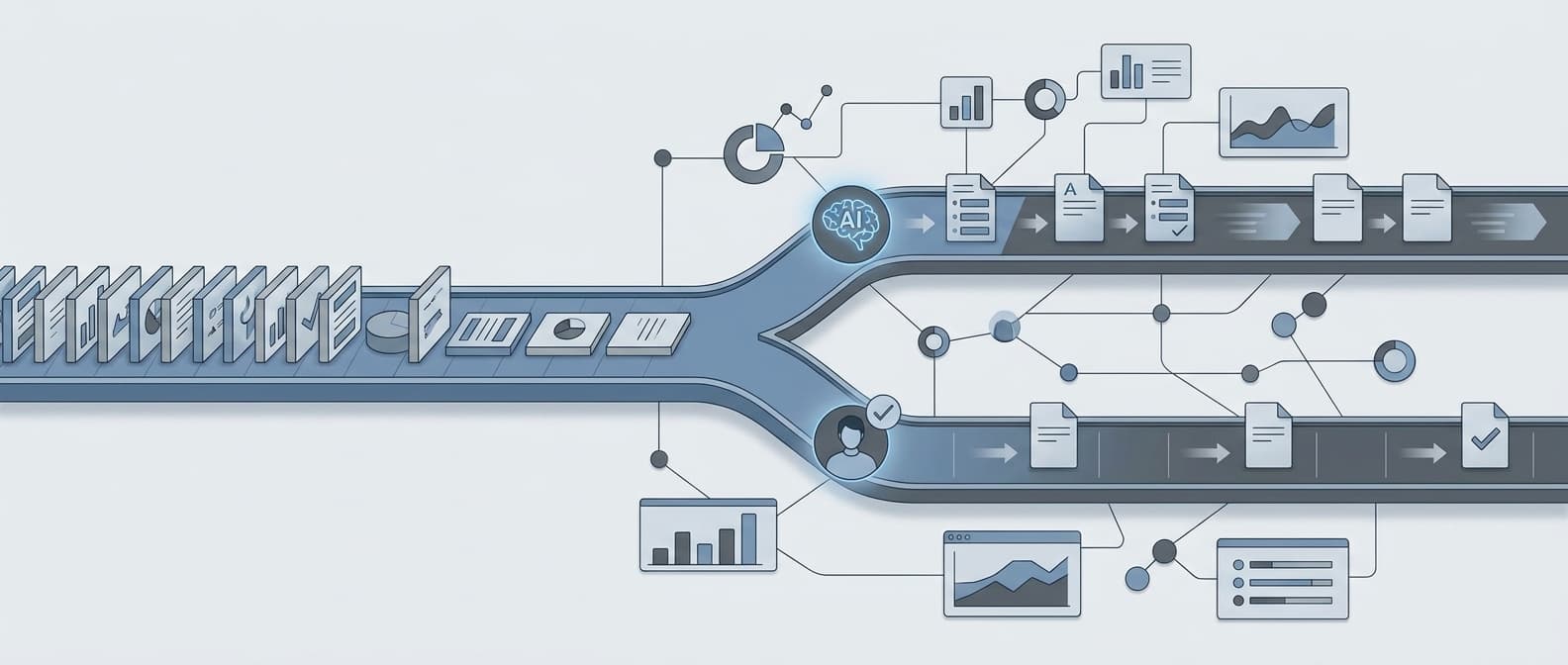
What is the first piece of work you can put in a queue, run through an agent, and review without guessing what happened?
That is usually where the first useful AI workflow starts.
Not with a broad mandate like "automate sales" or "use AI in operations." Not with an agent that can read half your stack and write to the other half. With a queue.
That sounds less exciting. I still think it is the right place to begin.
Why the market is moving this way
The recent product signals are not subtle.
On 04/22/2026, OpenAI introduced workspace agents built around shared use, permissions, schedules, and analytics. On 04/28/2026, AWS pushed managed agents around identity, logs, and in-environment execution. Anthropic has been more blunt: multi-agent systems have a place, but most teams should be more selective than they think.
That matters because it tells you what buyers are starting to care about.
They are not only asking, "Can the agent do the task?"
They are asking:
- What work enters the system?
- Who reviews edge cases?
- What gets logged?
- What happens when confidence drops?
- How do we stop the workflow if it starts making bad calls?
A queue gives you practical answers to those questions. Fast.
A queue forces the scope to get real
Without a queue, "first agent" projects stay vague for too long.
The team talks in categories. Customer support. Lead follow-up. Document review. Ops automation.
None of that is scoped enough.
A queue forces the team to name the actual unit of work. One inbound lead. One support ticket. One invoice. One referral request. One uploaded document packet.
Now the workflow can be defined.
What fields are required?
What data can the agent read?
What output is expected?
Where does the result go?
What should happen when the input is incomplete?
That is the difference between an interesting concept and a production workflow.
The first version should feel a little boring
I do not mean low-value. I mean controlled.
The first useful agent usually does some version of this:
- Work enters a queue.
- The agent classifies or enriches it.
- The agent scores confidence against a rubric.
- High-confidence work gets drafted or routed.
- Low-confidence work goes to a human.
- Every action is logged.
That is not glamorous. It is also how teams avoid the classic demo-to-production crash.
If version one is trying to message customers, update core records, make judgment calls, and recover from missing data on its own, the team learns the hard way. Broad autonomy hides weak assumptions until the workflow touches real stakes.
Queue-first design does the opposite. It surfaces weak assumptions early.
Good first workflows share the same shape
The strongest first use cases are not random. They usually have four things in common.
First, they already have repeatable inflow. New leads arrive every day. Tickets stack up. Documents show up in batches. Internal requests wait in a backlog.
Second, they have a visible bottleneck. People are spending too much time sorting, checking, routing, or summarizing work before the real decision gets made.
Third, there is a clean handoff. The output lands in CRM, a help desk, a review queue, or some other system of record.
Fourth, mistakes are survivable. An imperfect score or draft is annoying. A bad billing update or an unsupervised customer escalation is expensive.
That is why I keep coming back to a short list of good first workflows:
- inbound lead qualification
- support triage
- invoice or expense review
- document intake
- internal request routing
These are not the flashiest examples. They are usually the fastest path to something that actually sticks.
A queue makes failure legible
This is the part teams underestimate.
When an AI workflow fails, the real problem is often not the miss itself. It is the confusion that follows.
Nobody knows what the agent saw. Nobody knows why it chose that output. Nobody knows whether the issue is bad source data, a weak rubric, the wrong threshold, or a permissions problem.
In a queue-based system, those questions are much easier to answer.
You can inspect the input. You can inspect the output. You can compare the result against the rubric. You can see which items were escalated and which ones slipped through. You can spot patterns instead of arguing from anecdotes.
That matters to founders because trust is fragile here. One messy rollout can sour a team on a useful workflow for months.
If the system is legible, you can fix it. If it is opaque, the team starts over from fear.
Start in recommendation mode, not hero mode
A lot of first-agent designs reach for full autonomy too early.
I get why. Full automation sounds like the win.
Most teams should earn that step.
A smarter version-one pattern is recommendation mode:
- draft the reply, do not send it
- score the lead, do not auto-reject it
- flag the invoice, do not approve payment
- summarize the document packet, do not write back to the system of record without review
This still creates value. It also gives the team a safer way to tighten prompts, rules, thresholds, and exception handling before the workflow starts making irreversible moves.
Later, if the logs are clean and the review burden is low, the team can automate more of the path.
The right metric is not "did it feel smart?"
The right metric is whether the queue moves better.
For a first workflow, I want to know:
- Did turnaround time improve?
- Did manual review time drop?
- How often did humans override the result?
- What percentage of items hit the exception path?
- Did downstream cleanup shrink or grow?
Those numbers are more useful than general enthusiasm.
I have seen teams love a demo and hate the workflow two weeks later because it created hidden cleanup work. I have also seen boring queue automations quietly win because they removed hours of repetitive sorting that nobody wanted to keep doing.
The second case is what production value looks like.
What founders should do first
If you are trying to pick the first AI workflow for your team, I would keep the filter tight.
Choose one queue where:
- volume is real
- the handoff is clear
- the rubric can be written down
- human review is acceptable in version one
- the result can be measured in time, accuracy, or throughput
Then define the rules before you expand the architecture.
That means the input, the output, the confidence threshold, the exception path, the owner, and the rollback step.
If those pieces are fuzzy, the problem is not the model. The problem is that the workflow is still too loose.
That is why the first useful AI agent should usually start with a queue.
It gives the team a contained place to learn. It makes the system inspectable. And it turns AI from a vague initiative into operational work that can actually improve.
That is where real traction tends to begin.
Frequently asked questions
What is the best first AI agent workflow?
Usually it is a queue-based workflow with a clear input, a scoring or review rubric, and a measurable handoff into a system of record.
Why should an AI agent start with a queue?
A queue makes work visible. You can see what came in, what the agent did, what got escalated, and where confidence dropped.
What business processes fit a first AI agent?
Lead qualification, support triage, invoice review, document intake, and internal request routing are strong starting points because the inflow is repeatable and the outcomes are easy to inspect.
Should the first AI agent take action automatically?
Usually no. Version one should lean toward recommendation, draft, or review mode before it moves into fully automatic execution.
How do you know if an AI queue workflow is working?
Track turnaround time, exception rate, human override rate, accuracy against a rubric, and whether downstream cleanup is going down instead of up.
If you want help choosing the right first workflow and designing the review rules around it, book a discovery call: https://calendly.com/martintechlabs/discovery