
Most teams still judge an AI workflow by the happy path.
Can it classify the intake. Can it draft the response. Can it route the case. Can it update the record.
That is useful. It is not the hard part.
The hard part starts when the workflow is unsure, blocked, risky, or wrong.
That is the moment that tells you whether the system is ready for production or just good at demos.
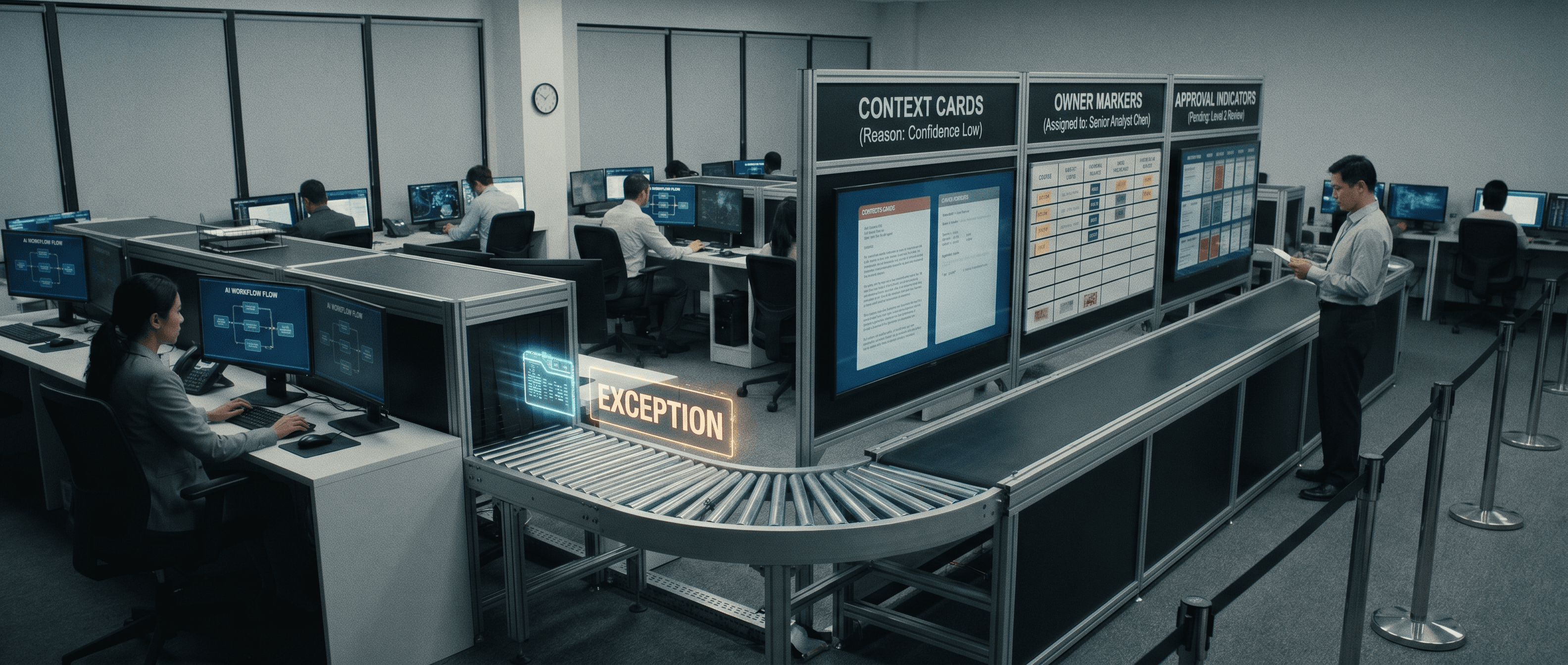
The real interface is not the polished first run. It is the exception path.
The happy path is the least interesting proof
An AI workflow can look great when the input is clean, the rules are obvious, and the next step is simple.
That does not prove much.
Production trust gets built when the workflow hits the messy case. A document is incomplete. A customer request falls outside the pattern. A system response looks inconsistent. An action carries more downside than usual. The workflow needs to know that this is not a normal lane anymore.
If it keeps moving with the same confidence and the same authority, the system is not being efficient. It is being reckless.
Exception routing is the real operating surface
I think this gets missed because teams focus on the automation step itself.
They ask how much work the system can do without help.
A better question is what the operator sees when help is needed.
Does the workflow route the exception to the right person.
Does it include enough context to act without starting the investigation from scratch.
Does it pause, narrow scope, or hold the action before the problem spreads.
Does the operator know what decision is being asked for.
That is the real interface. Not the pretty result when everything goes right.
The market is moving toward visible intervention surfaces
The reason this matters now is that the major platforms are making these operator surfaces easier to see.
OpenAI's 06/17/2026 and 06/18/2026 updates pushed scheduled-work visibility, approval settings, and management controls further into the product surface. That is not just product polish. It is a signal that production AI needs visible pause, review, and action boundaries.
AWS made a similar point in its 06/01/2026 AgentOps material. Governance, observability, and operational control are not side topics. They are part of the production stack.
Microsoft keeps making the same argument in a different way. The system around the model is what creates enterprise value. I think that is exactly right. The workflow matters. The surrounding control system matters more once the workflow touches live business operations.
A queue is only useful if the exception arrives ready to work
Lots of teams say they have a review queue.
That can mean almost anything.
A real exception path should carry the details an operator needs to act:
- what condition triggered the exception
- what the workflow was trying to do
- what system, record, or document is affected
- what authority was withheld or paused
- what next action is needed from the human owner
If the operator still has to reconstruct the whole story from logs, screenshots, and chat history, the queue exists, but the interface is still weak.
That is where trust breaks down fast.
NIST points to the same adoption problem
NIST's 05/18/2026 summary on AI agent security is a useful reality check.
The blocker is not usually that people think AI can never be useful.
The blocker is that they do not trust unclear control boundaries.
That maps directly to exception design.
If nobody can explain where uncertain work goes, who sees it, and how the workflow stays contained until a person decides the next step, then the business does not really have a controllable system.
It has a fast black box with a cleanup problem waiting behind it.
A simple exception-routing test
Before an AI workflow gets real authority, I would want four answers to be obvious.
- What conditions push work into a human review or exception lane?
- Does the operator get enough context to act immediately?
- Can the workflow pause or narrow authority while the issue is unresolved?
- What closes the loop before the next run repeats the same mistake?
If those answers are fuzzy, the workflow may have automation.
It does not have a real operational interface yet.
The MTL view
The happy path is the sales demo.
The exception path is the production test.
If your workflow cannot route ambiguous or risky work to the right person with the right context and a clear next action, then the system is still asking humans to absorb the mess after the fact.
That is not trustworthy automation. It is delayed manual work with extra exposure.
If you are trying to decide where AI can take real authority in your business, and what exception-routing and review model needs to exist before that happens, book a discovery call here:
https://calendly.com/martintechlabs/discovery
FAQ
Why is the exception path more important than the happy path in an AI workflow?
Because the happy path only shows that the workflow can complete normal work. Production trust depends on what happens when the system is uncertain, blocked, risky, or wrong, and whether that work gets routed to the right person with enough context to act.
What should an AI workflow include before it gets real authority in production?
It should define what conditions trigger human review, what context arrives with an exception, who owns the exception queue, and what action closes the loop before the workflow keeps running.
Is a pause button enough to make an AI workflow safe?
No. A pause control helps, but the workflow also needs clear exception routing, ownership, and enough run context for an operator to decide what happened and what should change next.
How can a team tell whether an AI workflow has a real operational interface?
If the team can explain where uncertain work goes, who receives it, what evidence arrives with it, and how the next run avoids repeating the same issue, the workflow likely has a real operational interface.