
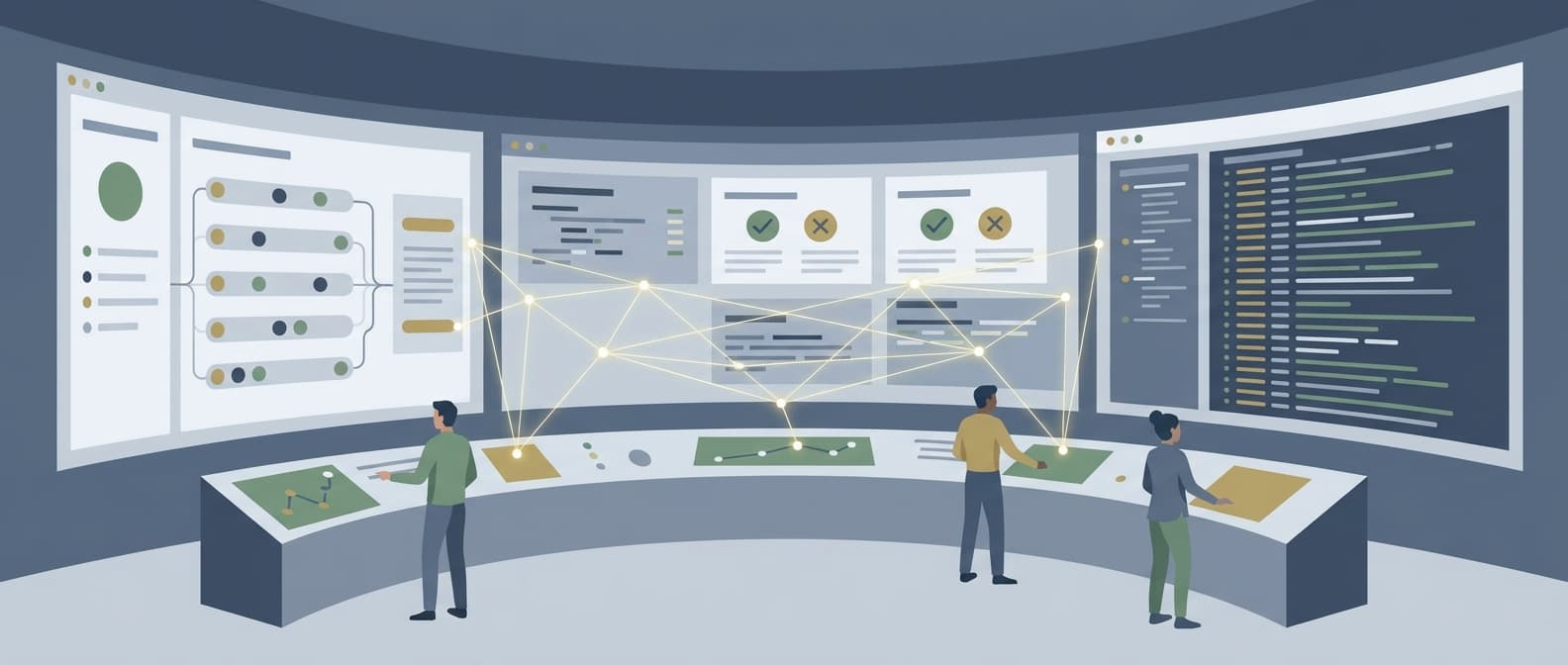
Most teams do not need another agent demo.
They need a way to decide what an agent is allowed to do, what it is not allowed to do, and what happens when it gets something wrong.
That is the operating model.
Without it, an AI agent is just a fast way to spread confusion across systems your team already depends on.
The market has moved past the demo
Over the last month, the strongest enterprise AI signals have all pointed in the same direction. The conversation is shifting from "can we build an agent?" to "how do we run agents inside real operations without creating a mess?"
That change matters.
OpenAI's recent enterprise push is centered on company-wide deployment, shared context, internal system access, and controls. AWS is selling managed agents around identity, logs, and in-environment execution. Anthropic is one of the clearer voices pushing teams to be selective about multi-agent complexity, and NIST keeps reinforcing that trustworthy AI gets built through concrete risk-management practice, not vague principles.
The pattern is clear. Buyers are less impressed by clever outputs. They care more about whether the workflow holds up once the agent touches CRM, support, finance, operations, or internal knowledge.
That is the gap MTL keeps seeing in the field. The model is rarely the main problem. The missing operating model is.
What an operating model actually means
"Operating model" sounds heavier than it is.
In practice, it means answering a short list of boring questions before the agent goes live:
- What exact workflow does this agent own?
- What systems can it read from?
- What systems can it write to?
- What decisions require human review?
- What counts as success?
- What counts as failure?
- Who gets alerted when it fails?
- How do you stop it quickly if it starts doing damage?
That is not enterprise theater. It is basic production hygiene.
If your agent drafts outreach, updates lead records, triages tickets, reviews invoices, or routes internal requests, it is already part of operations. Once it becomes part of operations, it needs operating rules.
Start with one bounded workflow
The easiest way to get this wrong is to start with a vague ambition like "we want an AI agent for sales" or "we want to automate support."
That scope is too loose.
A better starting point looks like this:
"New inbound demo requests enter a queue. The agent enriches the company, scores fit against our rubric, drafts a recommendation, and writes the result to CRM. Anything below confidence threshold or missing required fields gets routed to a human."
That is useful because it gives you boundaries:
- Clear input
- Clear output
- Clear handoff
- Clear review rule
- Clear place to measure value
This is why queue-based workflows are so often the right first step. A queue forces discipline. It makes it obvious what came in, what the agent did, what it skipped, and what still needs a person.
Permissions should feel boring
The more impressive an agent looks in a demo, the more careful you should be with permissions.
If the agent can read everything, write everywhere, and take action without review, you do not have an automation strategy. You have a control problem waiting for a bad day.
For most founder-led teams, the right default is narrower than they expect:
- Read access before write access
- Draft mode before auto-send
- Recommendation before execution
- Small system surface area before broad integrations
That sounds conservative. It is also how teams stay comfortable long enough to expand the system later.
One practical rule I keep coming back to: the broader the reach, the tighter the approvals.
An agent that summarizes internal notes is one thing. An agent that updates billing records, changes customer status, or sends messages to prospects needs a higher bar.
Observability is not just for engineers
Founders do not need the word "observability." They need the outcome.
They want to know:
- What happened?
- Why did it happen?
- Which record changed?
- Which source was used?
- Where did confidence drop?
- What is waiting on a person?
That is observability translated into business language.
If you cannot answer those questions, your team will stop trusting the workflow the first time something goes sideways. And something always goes sideways.
The point is not to promise perfect accuracy. The point is to make the system legible enough that people can debug it fast, intervene when needed, and keep using it.
Evaluation should happen before rollout, not after complaints
One of the more useful signals in the last 30 days is how evaluation is getting pulled earlier into the buying and deployment process.
That is the right move.
A lightweight evaluation plan does not need a giant research effort. It just needs to be real.
For a first agent workflow, that usually means:
- A representative sample of tasks
- A handful of known edge cases
- A pass or fail rubric
- Clear human review points
- A threshold for what can ship
If you skip this, you end up evaluating in production through avoidable errors. That is slower, more expensive, and harder on trust.
The first owner matters more than the first model
Teams spend a lot of time asking which model to use.
That matters. It is just not the first question.
The first question is ownership.
Who owns the workflow after launch?
Not who approved the experiment. Not who was excited about AI in the planning meeting. Who owns accuracy thresholds, exception handling, review queues, and improvement decisions once the workflow is live?
If the answer is "kind of everyone," the workflow is already in trouble.
Strong AI operations usually have one accountable owner, one bounded use case, one system-of-record handoff, and one clear definition of success. That setup is a lot less glamorous than a multi-agent storyboard. It is also much more likely to survive contact with reality.
What this looks like for a founder-led team
If you are a founder or operator trying to get your first useful agent into production, keep it simple:
- Pick one workflow that already has a queue.
- Define the rubric before you choose the stack.
- Limit the systems the agent can touch.
- Make human review part of version one.
- Log every action that matters.
- Decide who owns the workflow after launch.
Do that well and you can expand.
Skip it and you will end up with the kind of AI project people describe as "promising, but not reliable enough yet."
That phrase usually means the operating model never got built.
Frequently asked questions
What is an AI agent operating model?
An AI agent operating model is the set of rules that define what a workflow does, what systems it can access, what approvals it needs, how it is evaluated, who owns it, and how the team responds when it fails.
Why do AI agent projects fail in production?
Most production failures are operational, not magical. The workflow is too broad, permissions are too loose, review points are unclear, or nobody owns exceptions after launch.
What should a company define before deploying an AI agent?
At minimum: workflow scope, allowed actions, data access, review rules, success metrics, failure thresholds, escalation path, and rollback steps.
Should AI agents have full system access?
Usually no. The safer starting point is narrow read access, limited write paths, and approval gates around actions that affect customers, revenue, or systems of record.
What is the best first AI agent workflow?
The best first workflow is usually one with a queue, a clear rubric, and a measurable handoff into a system of record. Lead qualification, support triage, invoice review, and internal request routing are common starting points.
How do you evaluate an AI agent before launch?
Use a representative sample of tasks, define pass or fail criteria, test failure cases, and set explicit human review points before the workflow touches live operations.
The companies getting real value from AI are not the ones with the flashiest demos.
They are the ones willing to make the system boring in the right places.
If you want help choosing the right first workflow and designing the controls around it, book a discovery call.