
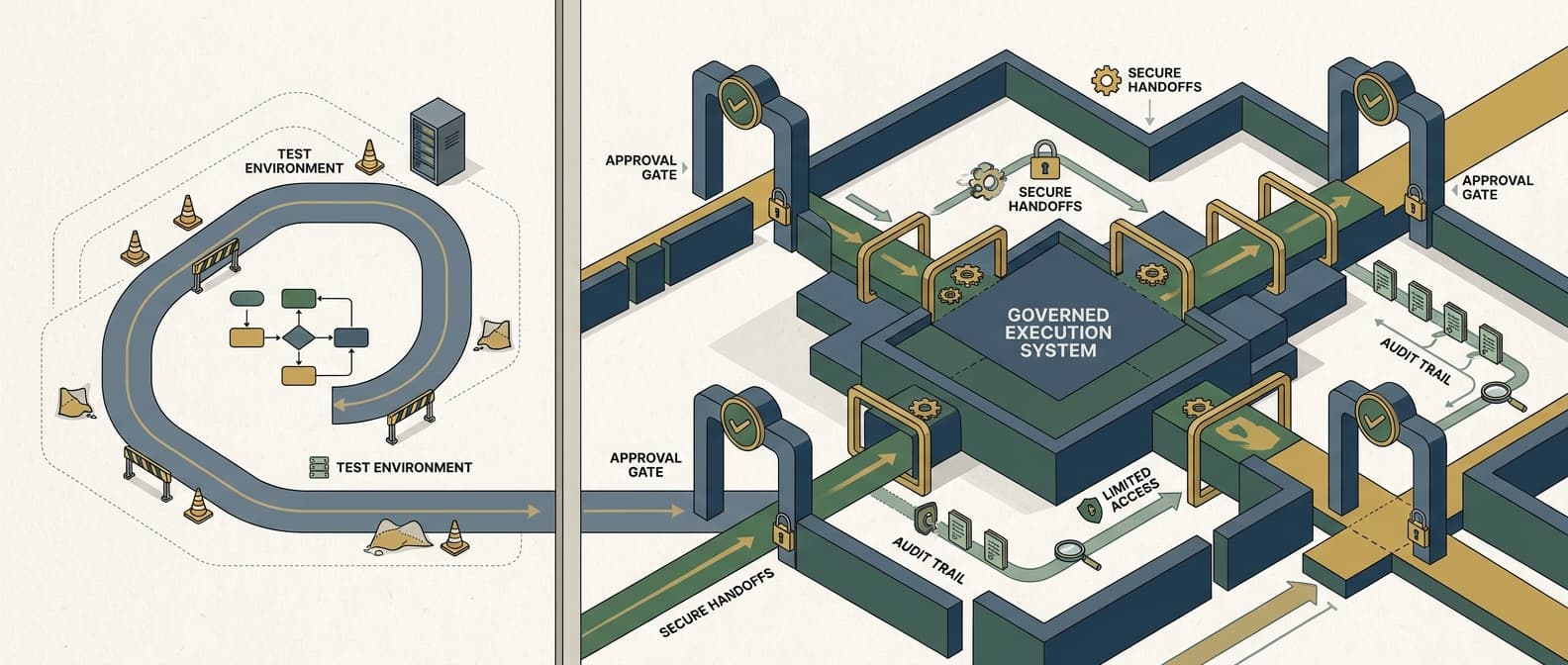
There is no shortage of AI pilots now.
Most teams have already seen a model summarize a document, classify a queue, draft a response, or extract fields well enough to get people interested. That part is not the bottleneck anymore.
The bottleneck is turning that useful demo into something the business can actually run.
That is why I think the market is moving from AI pilots to execution systems.
The question is not just "can the model do the task?" It is "can this workflow operate inside our real systems with the right scope, the right approvals, and evidence we can trust after the run?"
That shift shows up everywhere now. Microsoft keeps arguing that the system around the model is what changes the business. AWS keeps packaging approval, evaluation, and observability as part of the workflow product. OpenAI keeps adding publish controls and app permission modes. NIST keeps hearing the same concern from the market: agent security and control gaps are still slowing adoption.
That is not hype. It is a useful read on where buyers actually get stuck.
A pilot is not the same job as an execution system
A pilot answers a narrow question.
Can the model handle the core task well enough to justify deeper work?
That can be enough early on. You might need to know whether document extraction is viable, whether the support workflow can classify tickets correctly, or whether a summarization step produces anything useful at all.
An execution system answers a harder question.
Can this workflow run inside the business without creating authority problems, review gaps, or cleanup work nobody owns?
That is a different layer of work. It includes:
- scoped access to apps and data
- clear publish authority
- workflow identity
- review points around risky actions
- run history that survives a real incident
- evaluation and monitoring after launch
- a rollback path when output quality or workflow behavior drifts
If a pilot proves the model works, that is good news.
It still does not mean the system is ready to operate.
Why the market is moving this way
The strongest recent enterprise signals all point in the same direction.
Microsoft has been blunt about it. The surrounding execution system matters more than model novelty. That is the plainest version of the argument, and I think it is right.
AWS is pushing the same logic from the operations side. Approval-aware workflow patterns, evaluation, observability, and execution history are being treated as core parts of the product. Not optional polish.
OpenAI is pushing it from the admin surface. More teams can build and share agents, but the controls keep getting sharper around who can publish, what apps are in scope, and which actions require more care.
NIST is helpful here too because it confirms that security and control concerns are not edge-case objections. They are a real adoption blocker.
Put together, the signal is pretty clear.
The market has moved past "wow, the model can do this."
Now it is asking whether the workflow can be trusted.
What an execution system actually needs
I would keep the definition simple.
An execution system is a workflow that can do useful work inside a live business process and still stay inside boundaries the team can explain.
That usually means five things are true:
- The workflow has a clear job, not a vague ambition.
- The workflow has scoped authority over what it can read, draft, route, and change.
- Risky actions have explicit review placement.
- The team can reconstruct what happened after a meaningful run.
- Someone owns the workflow after launch.
That is what separates an execution system from a smart demo.
A good demo proves possibility.
A good execution system proves responsibility.
Where teams lose time
The common failure mode is easy to spot.
The team runs a promising pilot. Everyone gets excited. Then the real questions show up all at once.
Who can publish updates to this workflow?
What systems can it touch?
Does it run under a service identity or a borrowed user account?
Which steps stop for approval?
What do we see after a bad run?
Who owns it once it goes live?
At that point, another pilot usually does not solve much.
It may improve confidence in the model, but it does not answer the operating questions that are now blocking rollout.
That is why a lot of companies think they have a model problem when they really have an execution-system problem.
A simple way to tell where you are
If you are not sure whether you still need a pilot or now need an execution system, ask four direct questions:
- Has the team already proven the workflow can do the core task on real inputs?
- Are the next blockers about permissions, approvals, identity, integrations, or monitoring?
- Can the team explain what authority the workflow has and what evidence survives after it runs?
- Would another pilot create new learning, or mostly delay rollout design?
If the first answer is no, you probably still need a pilot.
If the first answer is yes and the next three start pointing at controls, ownership, and traces, you are already in execution-system territory.
That is usually the moment to stop asking for another demo and start designing the workflow people will actually trust.
The MTL view
This is the pattern we keep seeing.
Useful AI pilots are common now. Trusted execution systems are not.
The teams that move forward are usually the ones that stop treating governance as cleanup. They define authority, place reviews where they matter, keep real run evidence, and build the workflow around the business system it has to live in.
That is less glamorous than showing a clever prompt improvement. It is also where the real implementation work starts.
If connector scope is the immediate bottleneck, read Your Connector Approval Is Not Your Runtime Safety Model. If the next operating question is workflow identity, read Your AI Workflow Needs Its Own Identity Before It Touches a Live System.
If your team has a pilot that looks promising but keeps stalling on permissions, approvals, ownership, or rollout design, book a discovery call:
https://calendly.com/martintechlabs/discovery
Sources
- Microsoft: https://blogs.microsoft.com/blog/2026/05/21/from-ai-pilots-to-enterprise-impact-why-execution-is-the-new-differentiator/
- Microsoft: https://blogs.microsoft.com/blog/2026/06/02/ai-alone-wont-change-your-business-the-system-running-it-will/
- AWS: https://aws.amazon.com/blogs/machine-learning/agentops-operationalize-agentic-ai-at-scale-with-amazon-bedrock-agentcore/
- OpenAI Help Center: https://help.openai.com/en/articles/10128477-chatgpt-enterprise-edu-release-notes
- NIST: https://www.nist.gov/publications/summary-analysis-responses-request-information-regarding-security-considerations-ai
FAQ
What is an AI execution system?
It is a production-ready workflow that combines model behavior with scoped access, review rules, runtime evidence, and ownership inside real business systems.
How is an execution system different from an AI pilot?
A pilot proves that the model can do useful work. An execution system proves that the workflow can run inside live operations without creating authority, review, or audit problems.
When should a team move past an AI pilot?
Usually when the model has already shown it can handle the task and the next blockers are permissions, approvals, identity, integrations, and post-run evidence.
Why are enterprises asking more about controls than prompts?
Because once AI touches live systems, the business risk usually sits in what the workflow can read, change, trigger, and explain afterward.