
Most SaaS teams do not get in trouble because they picked the wrong model first.
They get in trouble because the demo works, the launch pressure builds, and nobody puts the same discipline around the AI feature that they would put around billing, auth, or search.
That is where the maintenance bill starts.
Custom AI development for SaaS companies can absolutely work. I think it is one of the strongest ways to make a product more useful when the workflow is a real fit. But the teams that get value from it usually do a few unglamorous things early. They scope the feature tightly. They define the fallback path before launch. They test on ugly data, not clean examples. And they make sure one person owns quality after the feature goes live.
If those pieces sound operational rather than inspirational, that is the point.
the first mistake is shipping the demo shape
A lot of SaaS AI work starts with a smart instinct. Customers want faster answers. The support queue is repetitive. Users are staring at too much text. Internal teams are doing classification or review work by hand.
Then the prototype looks good, so the team keeps the same shape for production.
The prototype was built around the best-case path. Production has weird records, missing context, low-confidence outputs, permission boundaries, impatient users, and support tickets waiting to happen.
The safer move is to narrow the first release even further before it launches. Not broader. Narrower.
One queue. One workflow. One promise to the user.
That might be:
- summarize a case before a human responds
- classify an incoming document before review
- draft a follow-up that still needs approval
- route an internal request to the right owner
Those are not the flashiest uses of AI. They are often the best first ones because the failure path is visible and the value is easy to measure.
treat the fallback path as part of the feature
I still think this is one of the cleanest tests for whether a team is building a real SaaS feature or just extending a demo.
Ask what happens when the output is weak.
If the answer is fuzzy, the rollout is not ready.
A real answer sounds more like this:
- low-confidence outputs go to manual review
- the feature can be disabled for a tenant or cohort quickly
- the previous non-AI path still works
- the team can trace what changed if quality drops
The fallback path is not a failure of ambition. It is part of the product design.
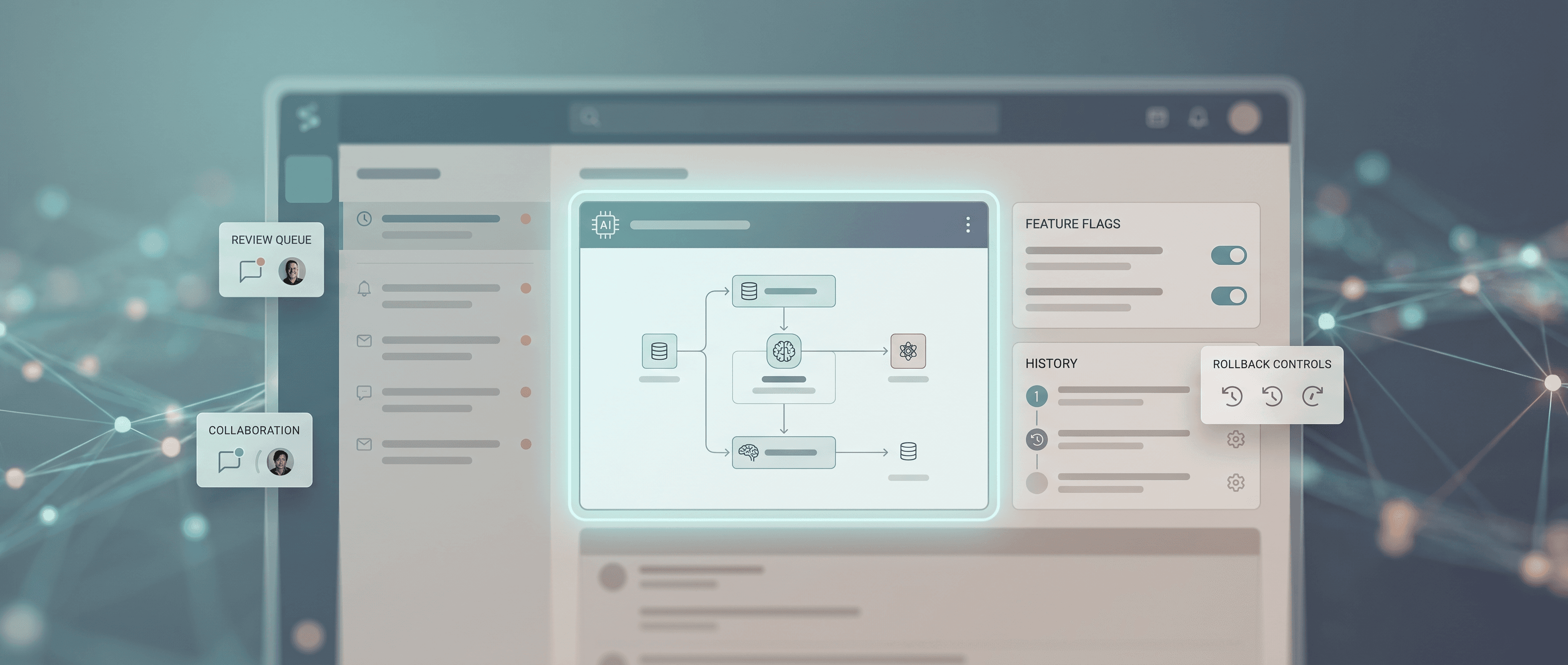
SaaS teams already understand this logic in other parts of the stack. They expect retries, feature flags, audit logs, and rollback plans for infrastructure changes. AI deserves the same seriousness because the failure mode is often less predictable and more visible to the user.
build an evaluation set before you debate prompts
Teams love to argue about prompt wording because it feels like progress.
The better question is whether you have a believable test set.
For custom AI development in SaaS, that means collecting examples from the real workflow and scoring them against the behavior you actually need. Not abstract benchmark performance. Not a nice looking demo transcript. Real inputs from the product.
I would want straight answers to a few things:
- what examples represent the normal workload
- which edge cases break trust fastest
- what failure rate is acceptable
- which outputs can move automatically
- which outputs need a review gate
Without that, the team is debating taste instead of quality.
permission boundaries matter more than most teams expect
The technical build is rarely the only risk.
In B2B SaaS, customers will ask where their data goes, which model provider touches it, what gets stored, and whether another customer could ever be exposed to the wrong context. They should ask.
If the team cannot explain the data boundary in plain English, the feature is not ready for a serious buyer conversation.
That does not mean every team needs the same architecture on day one. It does mean the answers need to be deliberate:
- which systems feed the feature
- what data is retained
- what is masked or excluded
- who can inspect outputs and logs
- how tenant separation is enforced
This is one of the reasons narrow first releases win. Smaller scope usually gives you a cleaner permission story.
do the rollout in stages, not as a product-wide reveal
The strongest SaaS teams I see do not treat AI launch like a homepage event.
They treat it like operational change management.
Start with internal use, or an opt-in beta, or a tightly defined customer cohort. Watch the outputs. Learn where review belongs. Find the ugly cases. See whether the feature saves time or just moves work downstream.
A staged rollout lets the team learn while the blast radius is still small. It also keeps you from turning a product experiment into a support problem that damages trust with the customers you were trying to help.
The right question is not "can we release this to everyone next month?"
It is "what is the smallest live rollout that teaches us whether this deserves a wider one?"
one owner matters after launch
Someone has to own the feature after the announcement post is gone.
Not in theory. In practice.
One person or one clearly accountable team needs to watch output quality, handle escalations, approve material changes, and decide when the feature needs more review or less automation.
This gets missed because AI launches often start as innovation projects. Then they quietly become core product behavior.
The handoff from experiment to owned feature is where a lot of teams lose control. Nobody is explicitly watching drift. Nobody knows which complaints are signal. Everyone assumes somebody else is looking at it.
That is how small quality problems become long-term maintenance costs.
the goal is not more AI in the product
The goal is a better product with less manual drag.
Sometimes that means the right first AI feature is visible to customers. Sometimes it is internal and boring and saves the team hours every week. Both are valid.
What matters is whether the feature survives contact with real usage without creating a second job for support, success, or engineering.
Custom AI development for SaaS companies works best when the first promise is small enough to keep. That usually means narrow scope, a real evaluation set, a clean data boundary, a staged rollout, and a fallback path that was designed before the first customer sees the feature.
That is not the loudest way to launch AI.
It is still the way I would trust more.
If your SaaS team is trying to add AI without turning the product into a permanent cleanup project, book a discovery call: https://calendly.com/martintechlabs/discovery