
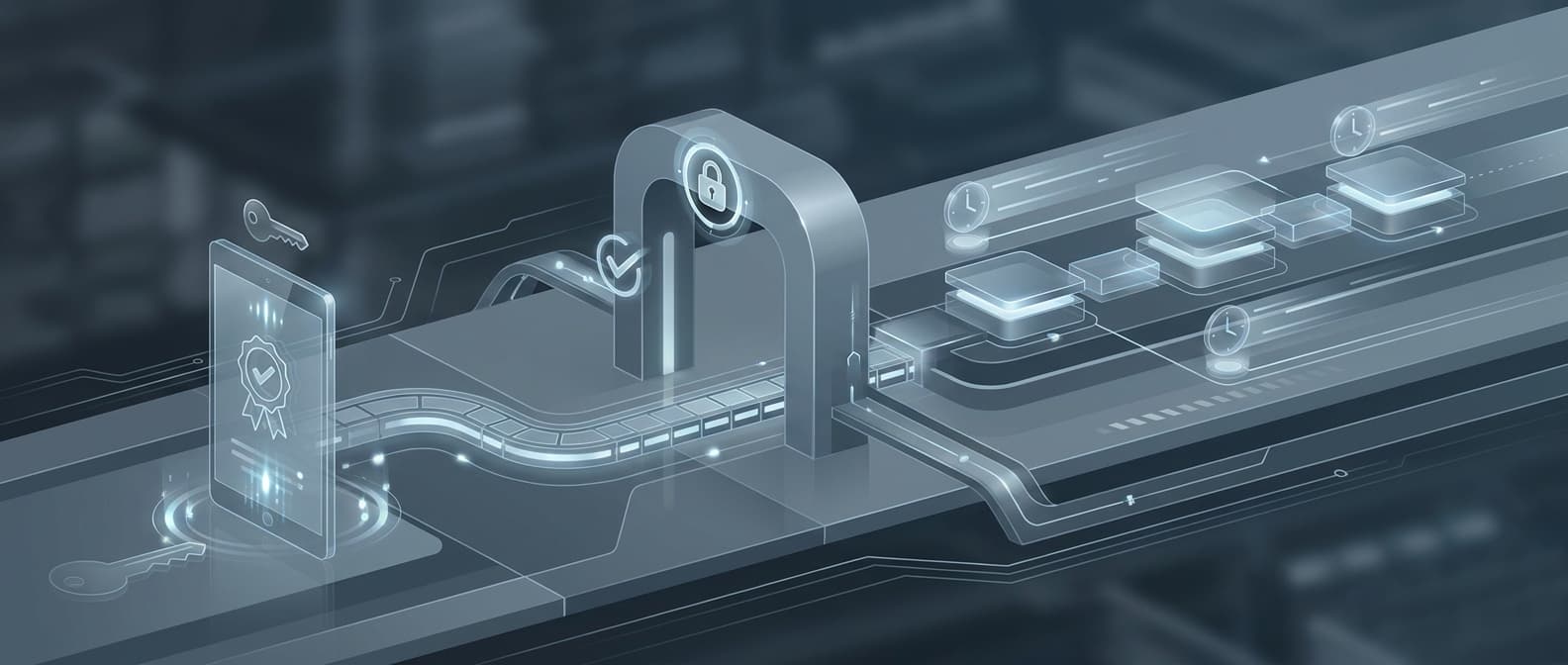
Most production AI rollouts do not stall because the model is terrible.
They stall because the team finally gets serious about what the workflow is allowed to do.
Who does it run as? What can it touch? Which actions stop for review? What survives in the logs after a bad run?
That is the real production stack.
I think a lot of teams still treat those questions like implementation detail. They prove the model can classify, summarize, extract, or draft something useful, then assume identity, approvals, and auditability can be layered on later.
Usually that is the point where the rollout slows down.
The model is only one layer of the system
The model matters. It has to do useful work on messy inputs, not just clean demo data.
Still, once the workflow is headed toward a CRM, finance queue, support tool, or document system, the bigger question changes. The issue is no longer "can the model produce a decent answer?"
It becomes "can this workflow operate inside a live business process without creating authority problems nobody wants to own?"
That is why the production stack is not just model plus prompt. It is model plus identity, boundaries, review logic, and evidence.
That shift is healthy. It matches what operators already feel in practice.
Service identities are where trust starts
The fastest way to keep a workflow in pilot mode is to let it run under a borrowed human account and promise the cleanup will come later.
It sounds harmless at first. The workflow already works. Somebody on the team already has access. The connector is easier to wire up that way.
Then reality shows up.
The person changes roles. Access is broader than the workflow should have. Nobody can cleanly explain which actions came from the workflow and which came from the employee. Revocation gets awkward. Incident review gets slower because the identity boundary was fuzzy from day one.
That is why service identity design matters so early. A production workflow should have its own narrow operating boundary. The team should know what it can read, what it can draft, what it can trigger, and what it absolutely cannot do on its own.
This is also where a lot of "AI strategy" conversations get more concrete. The workflow is not risky because it is intelligent. It is risky because it has authority.
Approval gates should sit at the risky step, not at the end
I still see teams add a generic approval button once everybody gets nervous.
That feels responsible, but it often solves the wrong problem.
If the workflow already queried the wrong data, wrote into the wrong staging table, or prepared an action without enough context, a last-minute approval click does not magically fix the design. It just makes a human share the blame.
Good approval gates are more specific than that.
They sit before the irreversible or high-impact action. They show the reviewer enough context to make a real decision. They define who is allowed to approve that class of action. They leave a record behind after the step is accepted, rejected, or escalated.
That is very different from "we added human-in-the-loop."
In practice, the useful question is simple: where is the first point in the workflow where a mistake becomes expensive?
Put the review there.
For a support workflow, that might be before a customer-facing reply is sent.
For a finance workflow, it might be before anything updates a payment, ledger, or exception record.
For a sales workflow, it might be before the system changes account status, ownership, or downstream routing in the CRM.
Audit trails are not a compliance side quest
The audit trail is what turns a nervous rollout into an explainable one.
If something goes wrong, the team should not have to piece the story together from screenshots, Slack messages, and half-remembered prompt changes.
They should be able to answer a few direct questions:
- what input the workflow received
- what systems or tools it touched
- what action it attempted
- whether a human reviewed the risky step
- what actually changed afterward
That is the minimum useful record.
Without it, every incident becomes an argument. People debate whether the problem came from the model, the connector, the workflow branch, the reviewer, or the target system. The team burns time before it even reaches the fix.
With it, a bad run is still annoying, but at least it is diagnosable.
That difference matters more than people admit.
The rollout usually stalls in the same sequence
The pattern is familiar.
First, the team proves that the model can do the task. That part goes well.
Then the workflow gets closer to a live system and the real blockers show up:
- nobody agrees on the workflow identity
- the connector scope is broader than the process should allow
- the approval step is too generic to be useful
- the logs are not strong enough to reconstruct a bad run
At that point, another round of prompt tuning does not solve the actual problem.
The model might improve. The rollout still stays stuck.
That is why I think teams should start describing production AI as an operating system question, not just a model question. The output quality matters inside the boundaries. It does not replace the boundaries.
A practical production standard
Before an AI workflow touches a live business system, the team should be able to answer four things without hand-waving:
- What identity does this workflow run under?
- Which actions are automatic, and which ones stop for review?
- What evidence survives after each meaningful run?
- Who owns the workflow once it is live?
If those answers are clean, the rollout has a real chance.
If those answers are vague, the team probably has a promising pilot. It does not yet have production infrastructure.
That is the gap most companies are actually trying to close.
If the immediate problem in your environment is borrowed workflow access, read Your AI Workflow Needs Its Own Identity Before It Touches a Live System. If your connector is approved but the runtime control model is still vague, read Your Connector Approval Is Not Your Runtime Safety Model.
If your team is stuck between a useful AI pilot and a workflow you can safely run inside real operations, this is usually where the work starts. Our services page shows how MTL helps teams move from experimentation into production systems, and you can book a discovery call here:
https://calendly.com/martintechlabs/discovery
FAQ
Why do service identities matter in production AI?
Because a workflow needs its own narrow authority in production. If it runs through a borrowed human identity, ownership, revocation, and audit attribution get messy fast.
What should an AI workflow approval gate actually do?
It should stop the risky step, show the reviewer enough context to make a real decision, and record who approved what and when. A bare approve button is not enough.
What belongs in an AI workflow audit trail?
Teams should be able to reconstruct what the workflow saw, what tools it invoked, what action it attempted, whether a human reviewed it, and what changed in the target system.
When is an AI workflow ready for production?
Usually when the core task already works and the remaining rollout questions are about scoped identity, approval placement, system handoffs, and post-run evidence.