
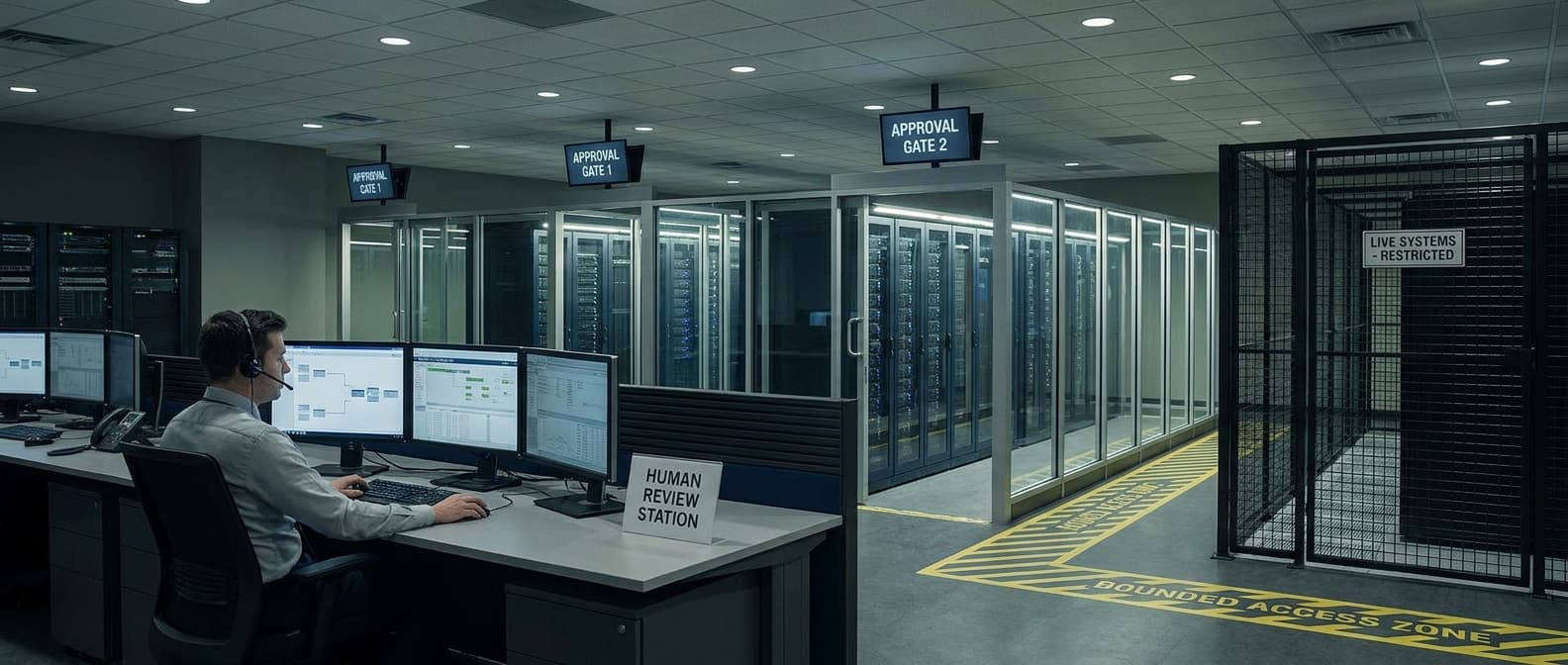
Teams still talk about governance as if it starts after the useful AI workflow already exists.
That framing falls apart in production.
The moment a workflow can update a CRM record, route a support case, draft a finance document, trigger a downstream tool, or publish customer-facing content, governance stops being a side conversation. It becomes part of the thing you are shipping.
That is because live-system access changes the category.
You are no longer judging whether the model can produce a decent answer. You are deciding what authority the workflow has, where it needs review, how it pauses, and what evidence survives after a bad run.
Those are product decisions.
Useful output is not the whole product
A lot of AI teams still split the work into two buckets.
First, build the useful workflow.
Later, add the governance layer.
I think that split causes real trouble.
If the workflow can touch production systems, governance is already shaping the user experience. It decides whether a risky action stops for review, whether the workflow can move from read to write, whether an operator can pause the next run quickly, and whether anyone can explain what happened after something goes wrong.
That is not cleanup work.
That is the product surface the operator will actually trust or reject.
The platforms are making this harder to ignore
The market is moving in that direction pretty openly.
AWS said on 06/01/2026 that governance and security sit at the front of the AgentOps stack, not at the end. Google keeps framing enterprise agents around identity, gateways, observability, and control. OpenAI's 06/17/2026 and 06/08/2026 updates made scheduled-work management and connected-app approval settings much more visible in normal product surfaces.
That pattern matters.
It shows that production AI is being packaged less like a clever prompt layer and more like an operating system for bounded work. Teams are being taught to expect review paths, action controls, and lifecycle visibility as part of the product itself.
Microsoft has been making the same point in a different voice. The system running the AI is what changes the business, not the model in isolation.
That is a useful commercial signal for MTL's kind of buyer.
The buyer does not just need a model that can do the task. The buyer needs a workflow that can be trusted once it crosses into real operations.
Governance shows up in boring but expensive places
This is where a lot of teams get misled by a strong demo.
The workflow can summarize cases. It can draft messages. It can classify intake. It can prepare updates.
Fine. None of that answers the production questions.
Can it touch live records or only suggest changes.
Which step still needs a person before the workflow writes data, routes something sensitive, or publishes anything public.
Who can pause the workflow when today's run looks wrong.
What survives after the run so the team can explain it later.
Those are not legal or procurement questions that appear after the real work is done. Those are operating questions that define whether the workflow is usable at all once it matters.
If the workflow can act, governance is part of the shipped behavior
This is the simplest way I know to frame it.
If your workflow can act inside production systems, governance is not around the product. It is in the product.
It includes things like:
- the identity the workflow runs under
- the exact tools and actions it can access
- where it stops for review
- who can pause or escalate it
- what evidence remains after it runs
Take any one of those away and the workflow changes in a meaningful way.
Remove approval points and you changed the risk profile.
Remove scoped authority and you changed the blast radius.
Remove run evidence and you changed the support burden after a failure.
Remove pause paths and you changed how long a bad run can keep doing damage.
That is product behavior, even if teams still like to label it governance.
NIST is one reason this keeps slowing adoption
The NIST summary published on 05/18/2026 still matters here.
It is useful because it does not frame these concerns like abstract fear. It frames agent security and control uncertainty as real adoption blockers.
That lines up with what happens on the ground.
Teams do not usually freeze because the model seems too weak. They freeze because the workflow can do something meaningful, but the control story is still fuzzy. Nobody wants to own the moment where a workflow touched the wrong system and the only explanation is "we thought the guardrails were probably fine."
That hesitation is rational.
A simple test for whether governance is really built in
Before I would trust a production AI workflow with live-system authority, I would want four answers to be easy:
- Can the team explain the workflow's authority in one sentence?
- Can they name which actions still require a person before records change, content publishes, or a downstream system gets updated?
- Is there a clear pause or escalation path when the workflow hits a risky step or a suspicious output?
- Can operators explain a bad run without reconstructing the event from Slack and memory?
If those answers are weak, governance is probably still living in docs, side conversations, and unstated assumptions.
It is not in the workflow yet.
The MTL view
The useful mistake in this market is thinking governance starts after the workflow proves it can work.
In production, governance is part of what makes the workflow work.
It is the difference between a system that can do something interesting and a system a business will actually trust with live operations. Once a workflow can touch production systems, authority design, review placement, pause controls, and post-run evidence are not overhead. They are part of the delivered product.
If the immediate gap in your environment is still approval versus runtime control, read Your Connector Approval Is Not Your Runtime Safety Model. If the workflow still runs under borrowed or vague authority, read Your AI Workflow Needs Its Own Identity Before It Touches a Live System.
If your team has an AI workflow that looks promising in demos but still feels risky the minute it gets near live systems, that tension usually means the governance layer is still outside the workflow instead of inside it.
Book a discovery call here:
https://calendly.com/martintechlabs/discovery
Sources
- OpenAI Help Center (06/17/2026): ChatGPT release notes
- OpenAI Help Center (06/08/2026): ChatGPT Enterprise & Edu release notes
- AWS Machine Learning Blog (06/01/2026): AgentOps: Operationalize agentic AI at scale with Amazon Bedrock AgentCore
- Google Cloud Blog (04/22/2026): Welcome to Google Cloud Next '26
- Google Cloud Blog (04/22/2026): Introducing Agent Gateway, ISV ecosystem for security and governance
- Microsoft Official Blog (05/21/2026): From AI pilots to enterprise impact: Why execution is the new differentiator
- Microsoft Official Blog (06/02/2026): AI alone won't change your business. The system running it will.
- Microsoft Official Blog (06/16/2026): Achieving success with AI
- NIST (05/18/2026): Summary analysis of responses to request for information regarding security considerations for AI
FAQ
When does governance become part of an AI workflow instead of a separate review layer?
It becomes part of the workflow as soon as that workflow can touch a live system. If it can read, route, update, or publish in production, authority, review, and evidence are part of the shipped experience.
Why is governance not just compliance overhead for production AI?
Because governance decides what the workflow can do, who can stop it, where a person still needs to review it, and how the team explains a bad run. Those are operating features, not paperwork.
What should a team define before letting an AI workflow act in production?
They should define the workflow's identity, system access, approval points, pause path, and post-run evidence. If those are still vague, the workflow is not really production-ready.
How can an operator tell whether governance is actually built into the workflow?
If the operator can explain the workflow's authority, risky review points, escalation path, and bad-run evidence without digging through side documents, governance is probably built in. If not, it is still floating around the workflow instead of inside it.