
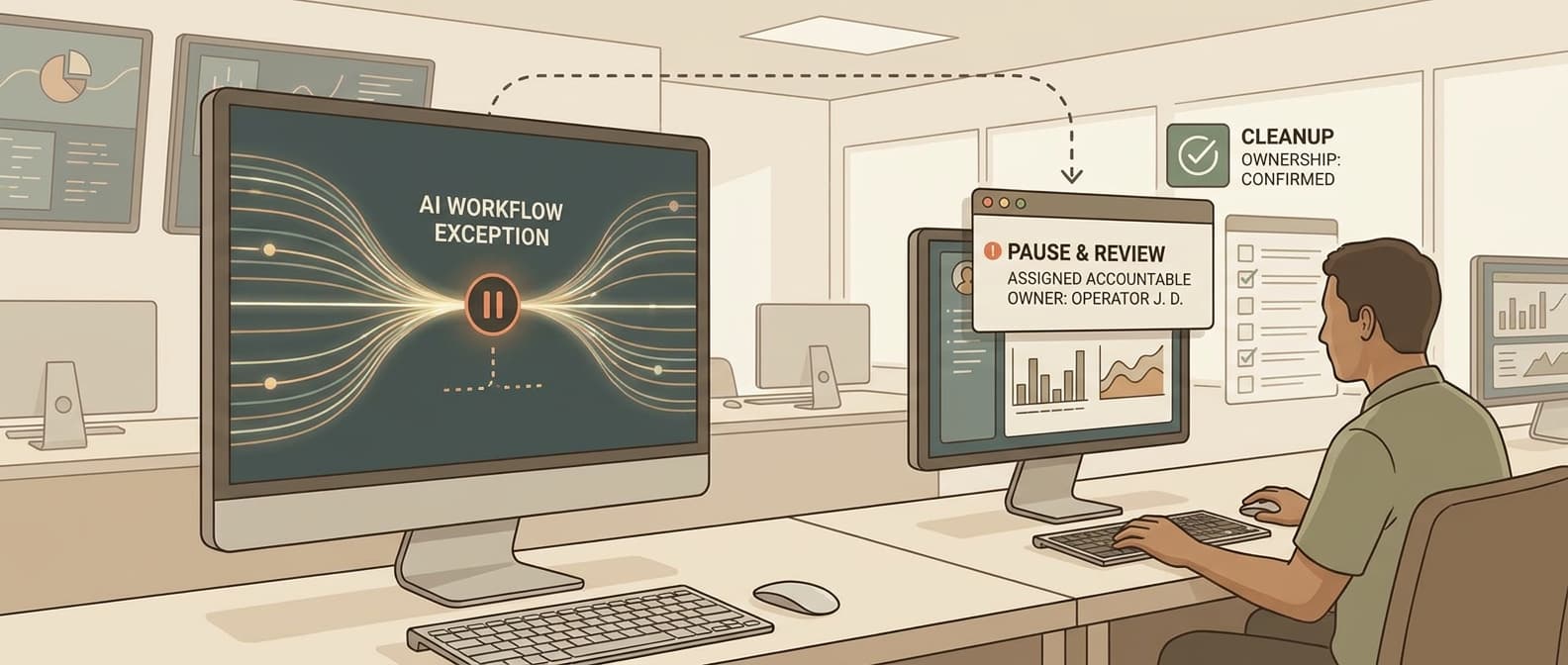
The real production question is not whether the AI can do the task.
It is this.
Who owns the mess after a bad run?
A lot of teams still treat that like an implementation detail. They focus on whether the workflow can classify intake, draft a response, update a record, route a case, or push work into another system.
That is only half the story.
If the workflow gets something wrong in a live environment, somebody has to do more than notice it. Someone has to stop it, figure out what happened, clean up the downstream damage, explain the failure to the people affected, and decide what changes before the next run.
If nobody owns that before go-live, the workflow is still a demo with extra confidence.
Bad runs are operating failures, not just model failures
Teams love to talk about model quality.
Did it summarize well. Did it classify correctly. Did it pick the right next step.
Those questions matter. They are just not the ones that hurt most when a workflow gets real authority.
The expensive problems usually show up one layer lower.
The workflow updated the wrong CRM record. It pushed the wrong document into review. It missed an approval step. It sent something that now needs manual cleanup in three places. Or it kept running after the team already knew the output looked wrong.
That is not just an accuracy issue.
That is an ownership issue.
The model might have made the mistake. The business still needs a person or team who owns the response.
Microsoft keeps making the same point
Microsoft's 05/21/2026, 06/02/2026, and 06/16/2026 posts all point in the same direction.
The difference is not who has the best demo. It is who can turn AI into a system that runs real work with trust, repeatability, and measurable outcomes.
I think that matters because it forces the right conversation.
A real operating system for AI work has owners. It has escalation rules. It has someone who can make the call when a workflow should pause, when a downstream correction needs to happen, and when the process itself needs to change.
Without that, "production" usually means the workflow is live right up until the first ugly exception.
Controls help. Ownership is what makes them useful
AWS put governance and security at the front of its AgentOps framing on 06/01/2026. OpenAI's 06/17/2026 scheduled-task update made pause, resume, edit, and management surfaces more visible. That is a good sign for buyers because operator controls are becoming more normal and easier to discuss.
But controls by themselves do not solve the problem.
A pause button is useful when somebody knows they are supposed to press it.
An approval gate is useful when somebody owns the decision on the other side.
Run history is useful when somebody is responsible for reading it, deciding what failed, and fixing the next run.
This is where a lot of teams get stuck. They add safety features, but they still never assign cleanup ownership. So the controls exist, yet the workflow still has no real operator.
NIST is a good reality check here
NIST's 05/18/2026 summary on AI agent security said that respondents broadly saw agent security issues as adoption blockers and that existing cybersecurity practices need adaptation for agent systems.
That lines up with what you hear in real projects.
The objection is rarely, "We do not think the model can do anything useful."
It is more often, "We do not know who owns the failure if this thing touches a live system and gets it wrong."
That is a healthy objection.
If the workflow can create operational damage, then cleanup ownership is part of the design. It is not a post-launch chore.
The easiest production-readiness test I know
Before a workflow gets real authority, four answers should be immediate.
- Who triages the bad run when it touches a live system?
- Who can pause the workflow or escalate it?
- Who owns the downstream cleanup if records, drafts, tickets, or documents need repair?
- Who decides what changes before the workflow is allowed to run again?
If those answers are fuzzy, the workflow is not ready.
It does not matter how strong the demo looked.
Most teams assign builders, not owners
This is the pattern I keep seeing.
The team can name who built the workflow.
They can name who approved the project.
They can usually name who wants the time savings.
But they cannot name the operator who owns the ugly day when the workflow behaves badly in production.
That gap matters because cleanup work has to cross product, operations, and system boundaries fast. Somebody has to coordinate the human response, not just inspect the logs.
If nobody owns that response path, the business has created authority without accountability.
That is exactly the kind of thing that makes leadership lose trust in AI work after one bad incident.
The MTL view
Production AI is not just about useful output. It is about clean operating responsibility.
If a workflow can read, route, update, or publish in a live business system, then the business needs a named owner for the bad run before it needs another prompt tweak.
That owner does not have to fix every technical detail personally.
They do need clear authority to stop the workflow, coordinate cleanup, drive the review, and make sure the same failure does not quietly roll into the next run.
If your team cannot name that person yet, the workflow is not production-ready.
It is still borrowing trust it has not earned.
If your environment still cannot explain what happened after a failure, read If Your AI Workflow Cannot Explain a Bad Run, It Is Not Production-Ready. If the workflow can already touch live systems but governance still feels separate, read If Your AI Workflow Can Touch Production Systems, Governance Is Part of the Product.
If you are trying to decide where AI can take real authority in your business, and what operating model needs to exist before that happens, book a discovery call here:
https://calendly.com/martintechlabs/discovery
Sources
- Microsoft Official Blog (05/21/2026): From AI pilots to enterprise impact: Why execution is the new differentiator
- Microsoft Official Blog (06/02/2026): AI alone won't change your business. The system running it will.
- Microsoft Official Blog (06/16/2026): Achieving success with AI
- AWS Machine Learning Blog (06/01/2026): AgentOps: Operationalize agentic AI at scale with Amazon Bedrock AgentCore
- OpenAI Help Center (06/17/2026): ChatGPT release notes
- OpenAI Help Center (06/17/2026): Scheduled tasks in ChatGPT
- NIST (05/18/2026): Summary analysis of responses to request for information regarding security considerations for AI
FAQ
Why is cleanup ownership part of production readiness for AI workflows?
Because a live workflow can create downstream damage even when the model output looks fine at first. Someone has to triage the failure, stop the spread, repair records or actions, and decide what changes before the next run.
Is runtime evidence enough to make an AI workflow safe in production?
No. Runtime evidence helps the team understand what happened, but it does not replace a named owner who is responsible for triage, escalation, cleanup, and workflow changes after a bad run.
Who should own a bad AI run inside a business workflow?
The business needs a clearly named operator or team who has authority to pause the workflow, coordinate cleanup, and approve the next change. If that owner is vague, the workflow is not ready for real authority.
What should teams define before giving an AI workflow production authority?
They should define who triages failures, who can pause or escalate the workflow, who cleans up downstream damage, and what change gets made before the workflow runs again.