
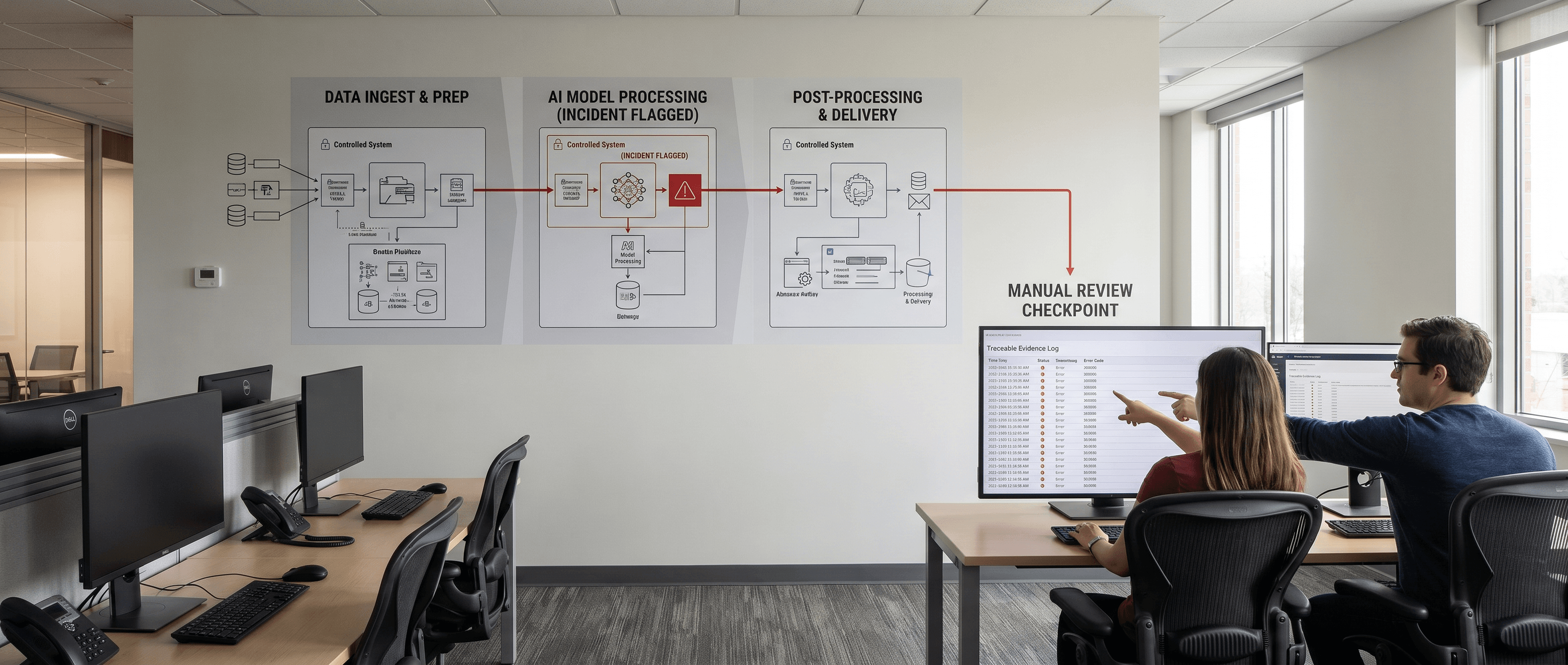
A workflow that works on a clean day is not the same thing as a workflow you can trust in production.
Trust gets tested on the ugly day.
The wrong draft goes out. A record changes in the wrong system. A reviewer thinks the step was manual when it was automatic. A workflow touches a downstream tool that nobody expected it to reach.
That is the real moment.
If your team cannot explain what happened without pulling three people into Slack and guessing from memory, the workflow is not production-ready yet.
It is still a black box with system access.
A good run proves usefulness. A bad run proves operability.
This is the mistake I see a lot.
Teams treat the first clean result like the trust milestone. The output looked good. The timing was fine. The demo landed. So the workflow starts to feel ready.
But production trust is not built by the happy path alone.
It is built when something goes sideways and the team can still answer basic questions fast:
- what triggered the run
- which tools it touched
- where a person reviewed or overrode it
- what changed downstream
- where the workflow should have paused
Without that, the team may have a useful workflow. It does not have an explainable one.
The product surfaces are starting to reflect this
The market is moving in that direction pretty openly.
OpenAI's 06/17/2026 and 06/18/2026 release-note sequence matters because it pushes scheduled-work visibility and connected-app approval controls into a surface normal users can see. People can inspect recurring tasks, check next run times, pause or resume them, and set approval behavior around connected-app actions.
That matters because visibility is not just a convenience feature.
It is part of the operating model. Teams want to know what is supposed to run, what did run, and when a human should get pulled back into the loop.
Google and AWS are reinforcing the same pattern from the platform side. Google's enterprise agent story keeps tying governance to identity, gateway control, and observability. AWS's 06/01/2026 AgentOps guidance keeps putting governance, security, evaluation, and observability in the main production conversation instead of treating them like cleanup.
The practical message is straightforward.
Teams are being pushed toward workflows they can inspect after the run, not just admire during the demo.
Bad runs are where weak control systems show up
When a workflow fails, the output is only one layer of the problem.
Operators still need to know whether the failure came from the model, the rule set, the input record, the connected tool, or the approval path around the step.
That sounds obvious. It usually is not obvious when the workflow is live.
Plenty of teams can tell you that an agent "did something wrong." Fewer can tell you:
- which exact tool path fired
- whether a human approved the risky step
- whether the workflow crossed from read to write
- what record or document changed
- whether the wrong behavior came from bad instructions or bad source data
If those answers take hours to reconstruct, the workflow does not really have runtime evidence. It has hope and partial logs.
NIST is still describing this as a real adoption barrier
That is one reason the NIST 05/18/2026 analysis still matters.
The headline is not just that agent systems create new security questions. It is that those concerns keep slowing adoption. Teams hesitate when authority boundaries are fuzzy and incident review is weak.
That hesitation is rational.
Nobody wants to explain to a customer, an operator, or a compliance lead that the workflow touched the wrong system and there is no clean record of why.
The minimum evidence standard I would want
Before I would trust an AI workflow in a live business process, I would want operators to answer four things quickly after a bad run:
- What triggered the run, and what inputs or source records did it start from?
- Which tools did it use, and did any of them write to a live system?
- Where did a human approve, override, or bypass the workflow?
- Can the team separate a model mistake from a bad rule, bad data, or a bad downstream action?
That is not overkill.
That is the line between a workflow you can operate and a workflow you are babysitting.
If the immediate gap in your environment is still scheduled-run control, read Scheduled AI Work Without Pause and Review Controls Is Just Cron-Driven Risk. If the immediate gap is still connector approval versus runtime authority, read Your Connector Approval Is Not Your Runtime Safety Model.
The MTL view
Production trust is not earned when the workflow looks smart on a clean day.
It is earned when the team can explain the bad day without fiction, guesswork, or archaeology.
That means runtime evidence. It means traceability. It means being able to say what happened, what changed, who reviewed it, and where the workflow should have stopped.
If your team already has a useful AI workflow but still feels uneasy about what happens after a bad run, that unease is probably valid. The next step is not more demo polish. It is a better operating record.
Book a discovery call here:
https://calendly.com/martintechlabs/discovery
Sources
- OpenAI Help Center (06/17/2026 and 06/18/2026): ChatGPT release notes
- Google Cloud Blog (04/22/2026): Introducing Agent Gateway, ISV ecosystem for security and governance
- AWS Machine Learning Blog (06/01/2026): AgentOps: operationalize agentic AI at scale with Amazon Bedrock AgentCore
- NIST (05/18/2026): Summary analysis of responses to request for information regarding security considerations for AI
FAQ
What counts as runtime evidence in an AI workflow?
Runtime evidence is the record that lets an operator reconstruct what happened during a run. That usually includes the trigger, tool path, approvals, outputs, downstream changes, and the point where the workflow should have paused or escalated.
Why is a successful demo not enough to trust an AI workflow in production?
Because clean demos do not show how the workflow behaves when inputs are messy, approvals are missed, or the wrong downstream system gets touched. Production trust comes from being able to inspect and explain the ugly run, not just celebrate the clean one.
How can a team tell if its AI workflow is still a black box?
If the team cannot explain who approved a risky step, which tool changed a live system, or whether the failure came from the model, the rule set, or the source record, the workflow is still a black box.
What should operators be able to answer after a bad AI run?
They should be able to answer what triggered the run, which tools were used, what changed, where review happened, and where the workflow should have stopped.