
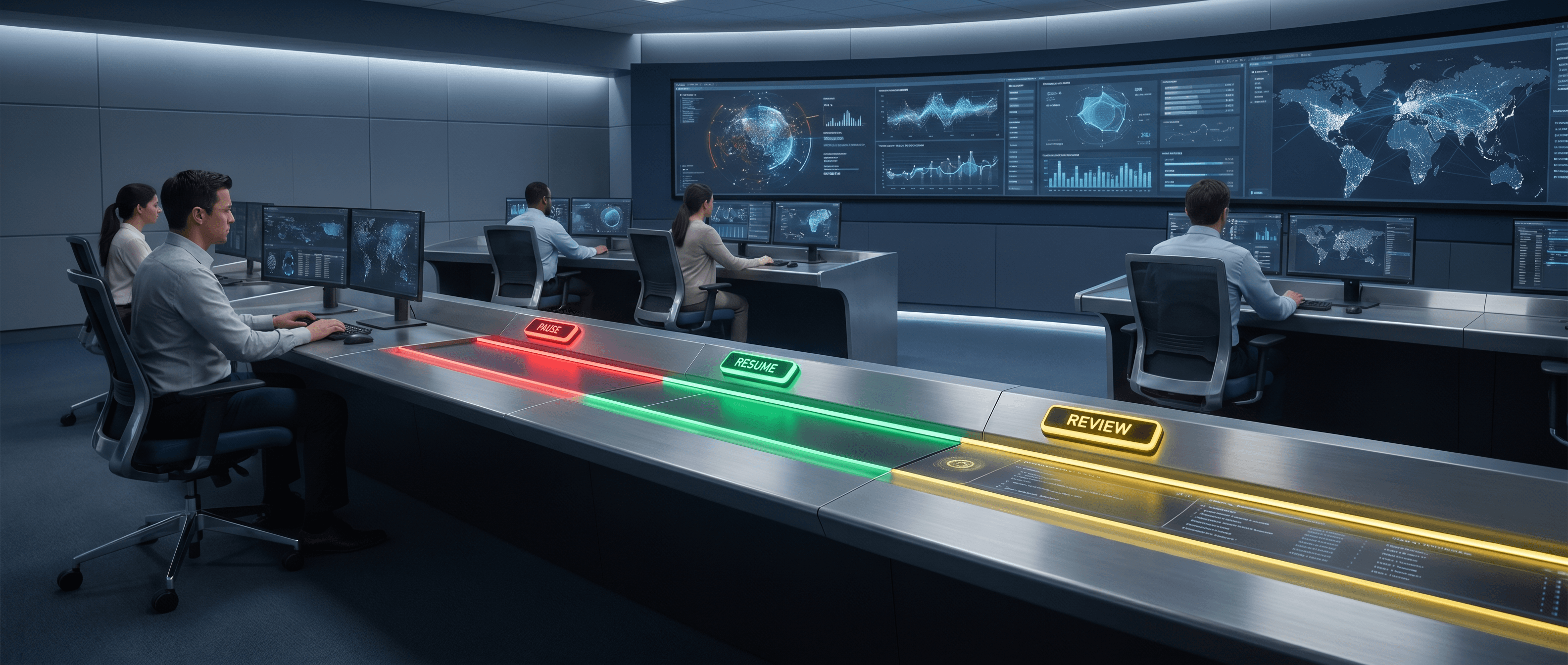
A lot of teams still talk about recurring AI work as if the hard part is getting it onto a schedule.
It is not.
The hard part starts right after that.
Once a workflow wakes up on its own, touches live systems, and keeps doing work without someone pressing the button each time, the question changes. It is no longer just "can we schedule this?" It is "can we stop it, inspect it, and defend it after it runs?"
That is the part many teams skip.
They add the schedule first. The pause controls, review logic, and run evidence come later, if they come at all. What they have then is not a production system. It is cron-driven risk.
Scheduling is not control
There is nothing wrong with scheduling work. Most useful operational systems depend on recurring jobs.
The problem starts when a team treats the schedule itself like proof of maturity.
If a workflow wakes up every morning to process documents, draft follow-ups, route tickets, update records, or prepare internal summaries, that workflow now has operating consequences. A bad run does not stay contained in the demo window. It creates rework for support, finance, operations, or whoever inherits the cleanup.
That is why recurring AI work needs a different standard from a one-off demo.
A one-off run can fail and teach you something.
A scheduled workflow can fail five times before anyone notices.
The market is quietly moving toward the same conclusion
The recent platform signals are useful because they show what enterprise buyers are being taught to care about.
OpenAI's 06/17/2026 release notes added a dedicated management surface for scheduled work. That matters less because it is new UI and more because it makes the operating model obvious. Teams want to see the next run, pause it, resume it, edit it, and delete it. That is not "nice to have" behavior. That is baseline control.
The 06/16/2026 workspace-agents guidance pushes the same point from another direction. Scheduled agents live inside a workspace with admin visibility, sharing controls, and management surfaces. The 06/08/2026 enterprise notes reinforce that connected apps and actions now belong inside explicit review modes and permission boundaries.
The message is pretty clear. Scheduled AI work is becoming a control-plane problem, not just a prompt problem.
Recurring workflows raise sharper questions than demos do
A demo usually answers one narrow question.
Can the model perform the task well enough to keep exploring?
Recurring AI work raises a different set of questions:
- who can pause it
- who can edit it
- which actions still stop for review
- what happens when a run misfires
- what evidence remains after the run
Those are not edge cases. They are the practical questions that show up once a workflow is close to live CRM records, support queues, finance reviews, or document operations.
This is where teams often confuse automation with autonomy.
A useful workflow can still be tightly controlled. In fact, the more often it runs, the more that control matters.
Review is not a failure to automate
I still see teams treat review steps like an admission that the workflow is not good enough.
I think that is backwards.
For a lot of recurring operational work, review placement is part of the product.
AWS has kept this logic visible for years in its workflow patterns. A job can run, wait for a callback, and continue after review. That is not a compromise. It is a practical way to let automation handle the repetitive path while keeping humans in the steps that can create real downstream damage.
The right design is not "remove every human from the loop."
The right design is "be explicit about which steps deserve human intervention, and make that intervention operationally clean."
That difference matters a lot in finance, healthcare, support operations, and any document-heavy workflow where one mistaken run creates hours of cleanup.
Where teams actually get burned
The common failure mode is easy to recognize.
The workflow works well enough in testing. It drafts something useful, classifies accurately enough, or moves work faster than the manual process. So the team schedules it.
Then the first real operating question shows up.
Who notices if it starts pushing bad records?
Who can pause today's run without breaking tomorrow's queue?
Can anyone reconstruct what happened last night?
If the workflow touched the wrong document set, routed the wrong customer, or triggered the wrong internal update, who owns the cleanup?
This is where weak systems get exposed.
The schedule exists. The operating model does not.
That is also why NIST's 05/18/2026 summary still matters. The concern is not abstract AI fear. It is that agent authority, security boundaries, and oversight still block trust in live systems. Scheduled work increases that pressure because mistakes repeat.
A better standard for scheduled AI work
Before a recurring AI workflow goes deep into production, I would want four direct answers:
- Can the team pause the workflow immediately without causing a second failure somewhere else?
- Can the team explain which steps proceed automatically and which steps still stop for review?
- Can the team reconstruct what happened after the last meaningful run?
- Would a mistaken run create cleanup work in CRM, support, finance, or document operations that nobody clearly owns?
If those answers are weak, the workflow is scheduled, but it is not production-ready.
That does not mean the workflow is useless. It means the next investment should go into control surfaces, review placement, and run evidence, not just better prompt tweaks.
The MTL view
The dangerous part of recurring AI work is not that it runs on a schedule.
The dangerous part is when the team mistakes scheduling for control.
Good production workflows do more than wake up at the right time. They run with clear authority boundaries, visible review rules, and enough evidence that an operator can explain what happened after a bad run.
That is the threshold that matters.
If your team has a recurring AI workflow that works in test mode but still feels risky the moment it touches live operations, that is usually the point where workflow design matters more than one more model experiment.
Book a discovery call here:
https://calendly.com/martintechlabs/discovery
FAQ
What makes a scheduled AI workflow production-ready?
A production-ready scheduled AI workflow has clear pause authority, explicit review points, scoped actions, and run history the team can inspect afterward. A cron expression by itself is not an operating model.
Why are pause and resume controls important for recurring AI tasks?
Because recurring work can keep creating damage after the first mistake. If a workflow cannot be stopped quickly, reviewed, and restarted safely, the team is relying on luck instead of control.
Should scheduled AI workflows always include human review?
Not on every step, but on the steps that can create real operational cleanup. If a run can change CRM records, move money, route sensitive documents, or trigger customer-facing actions, review placement should be designed on purpose.
What should a team be able to explain after a scheduled AI run?
They should be able to say what ran, what data it touched, what actions it took, where it paused, and who could intervene. If that story is fuzzy after one run, the workflow is not ready for more of them.