
What it actually takes to build an LLM application in production
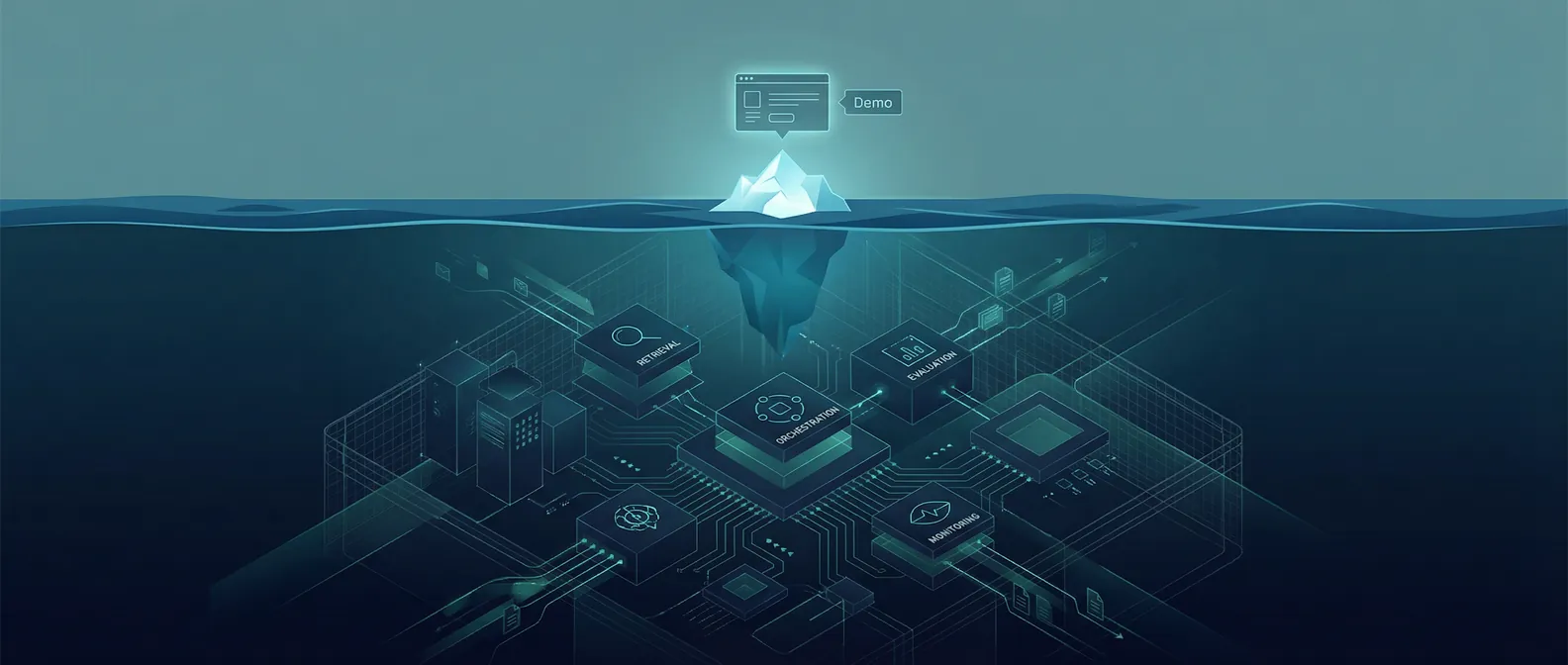
The demo always works. You chain a few API calls together, connect a model to your data, and within a few hours you have something that looks impressive in a walkthrough. The model answers questions. It summarizes documents. It does the thing.
Then you try to turn that into a production system and discover that the demo was maybe 10% of the actual work.
Building LLM applications for production is a real engineering discipline. It has its own failure modes, its own architectural considerations, and its own operational requirements. Most of them aren't obvious from the playground.
Here's what the other 90% actually looks like.
The gap between prototype and production
A prototype is built to demonstrate capability. A production system is built to be reliable, observable, maintainable, and cost-predictable across millions of inputs you didn't anticipate when you wrote the first version.
The specific challenges that separate the two:
Latency. LLM inference is slow compared to traditional software. A query that takes three seconds in development becomes a user experience problem at scale. You need caching strategies, streaming responses, async patterns, and sometimes model distillation or smaller models for lower-stakes tasks. Getting latency right usually requires architectural decisions you can't retrofit later.
Cost at scale. Running a demo costs almost nothing. Running a production system that processes 50,000 queries a day is a different calculation. Token costs add up quickly when you're including large context windows or chaining multiple calls. Production LLM systems need prompt engineering that balances quality against token efficiency, and monitoring that surfaces cost anomalies before they become billing surprises.
Unpredictable outputs. LLMs are not deterministic in the way traditional software is. The same input can produce meaningfully different outputs across calls. For some use cases, that's fine. For others, it breaks downstream systems that expect consistent formats. Production systems need output validation, structured output enforcement, retry logic, and fallbacks for when the model returns something unexpected.
Context and memory. The stateless API call pattern works for simple queries. It breaks down for anything that requires multi-turn context, user history, or long-running tasks. Production LLM apps often need a retrieval layer, a session management system, or both. Getting this architecture right early is much easier than refactoring it later.
The components of a production LLM system
A real LLM application isn't just an API wrapper. The systems we build typically involve:
An orchestration layer. Something that manages the sequence of calls, handles branching logic, passes context between steps, and coordinates between multiple models or tools. This can be a framework like LangGraph or a custom implementation. Both have tradeoffs.
A retrieval system. Most useful LLM applications need to work with your data, not just the model's training knowledge. That means a document store, an embedding model, a vector database, and a retrieval strategy. The quality of this layer is usually the biggest determinant of whether the system actually gives useful answers.
Guardrails and validation. Output validation that catches malformed responses, safety filters appropriate to your use case, and graceful fallback handling. These aren't optional extras. They're what makes the difference between a system you can deploy with confidence and one you're afraid to show users.
A monitoring and evaluation pipeline. You need to know when the system is producing bad outputs. Not just technical errors, but semantic failures where the model returns something syntactically valid but wrong or unhelpful. Building this requires defining what "good" looks like for your use case and instrumenting the system to track it.
Cost and usage tracking. Per-query cost visibility, usage patterns by feature or user segment, alerting for anomalies. This is table stakes for any system running at meaningful scale.
The engineering practices that matter most
A few things we've learned from building these systems:
Eval first, not last. The most common mistake is treating evaluation as something you do at the end to check whether the system is good enough. It should be continuous from the start. Before you optimize anything, you need a way to measure whether you've actually improved it.
Prompt engineering is real engineering. Prompts are the interface between your application and the model. They're also code, in a real sense. They should be version controlled, tested against a representative set of inputs, and maintained with the same care as any other component. A prompt that works well for 95% of inputs can fail badly on the other 5%.
Separate retrieval quality from generation quality. When an LLM application gives a wrong answer, the problem is often in the retrieval, not the model. The model can only work with what it's given. If the relevant context isn't being retrieved, no amount of prompt tuning will fix it.
Instrument early. Adding logging and tracing after the fact is painful. Build observability into the system from the start: log inputs, outputs, retrieved context, latency, and token usage at the query level. You'll need all of it when something goes wrong, and something always goes wrong.
What this means for your project
If you're planning to build an LLM application and you're scoping the work, two things are worth keeping in mind.
First, the prototype time estimate is not the project time estimate. The demo is fast. The production-grade version with proper retrieval, validation, monitoring, and cost controls takes significantly longer. Budget for the full system, not just the interesting part.
Second, the team you need is different from a standard software team. LLM application development sits at the intersection of software engineering and ML engineering. You need people who understand API integration and backend systems, but also retrieval architecture, prompt design, and model evaluation. That combination isn't as common as it looks.
If you're evaluating whether to build this internally or bring in outside help, the honest question is whether your team has done it before at production scale. Reading about it and building it are different things.
We've built LLM applications across document processing, support automation, internal knowledge tools, and customer-facing features. If you're trying to figure out what your specific build would actually require, book a discovery call and we'll walk through it with you.