
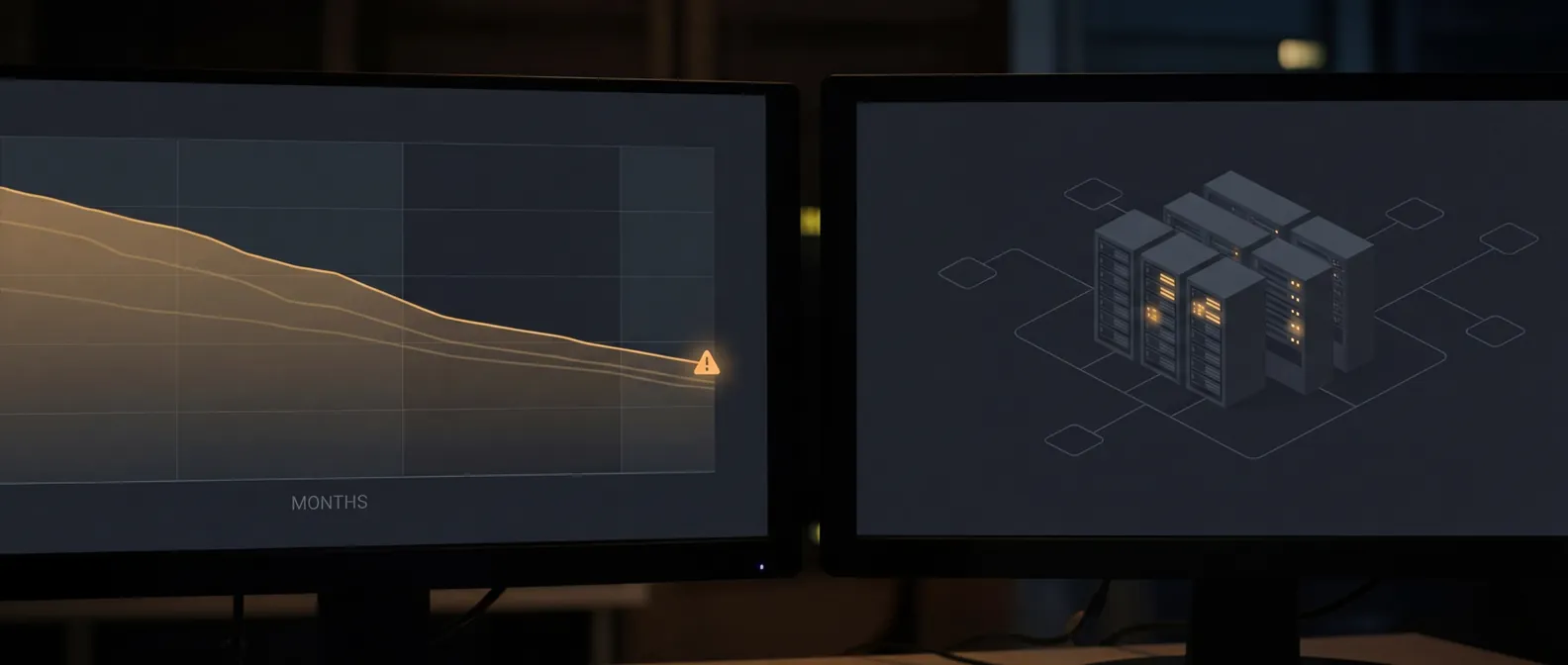
Why AI systems fail in production (and how to prevent it)
Most AI failures are not dramatic. There's no error message, no crash, no obvious signal that something has gone wrong. The system keeps running. It keeps returning predictions. The numbers just get slowly, quietly worse.
This is the failure mode that catches teams off guard. They shipped something that worked. It kept working, by some measures, for months. Then someone looked at the actual outcomes and realized the model had been making systematically worse decisions for the better part of a year.
Here are the four most common causes, and what you can do about each before they affect your system.
Data drift
When you train a model, you train it on a snapshot of the world at a specific point in time. The real world keeps moving. Customer behavior changes. Product lines evolve. The distribution of inputs shifts in ways you didn't anticipate. The model, which learned the old distribution, starts seeing a world that no longer quite matches what it was trained on.
This is called data drift, and it's the most common reason well-built AI systems degrade in production.
The insidious thing about data drift is that it's invisible without active monitoring. Your system health dashboards will show green. Requests are being processed. Responses are being returned. The degradation only shows up when you track the quality of model outputs over time, not just the operational health of the infrastructure.
The fix starts with monitoring. Before you deploy, define what "normal" looks like for your model's output distribution. Build checks that flag when that distribution shifts. And design your data pipeline so that retraining on recent data is straightforward, not a three-week project every time it's needed.
Missing feedback loops
An AI system that can't learn from its mistakes in production is one that will keep making them.
The most robust production AI systems have a path from "model made a prediction" to "we found out whether that prediction was right" and back to "we updated the model with that information." This loop can be automated, semi-automated, or fully manual depending on the stakes, but it needs to exist.
A lot of teams build the model without building the feedback loop, then discover later that they have no mechanism to improve the system with real production data. They're locked into retraining on historical data that may already be stale, rather than incorporating the ground truth that production use is generating every day.
If you're scoping an AI project, scope the feedback loop as part of the initial build, not as a future phase that may or may not happen.
Integration brittleness
The AI component of a system rarely fails in isolation. What typically fails is the connection between the model and the systems around it.
An upstream data schema changes and nobody tells the ML team. A feature that the model depends on gets renamed in a refactor. A third-party API the pipeline relies on changes its rate limits or response format. The model itself is fine. The scaffolding around it breaks.
This class of failure is more common than most teams expect, and it's particularly hard to catch in testing because integration tests tend to mock the external dependencies rather than testing against the real ones.
The practical countermeasure is treating the full pipeline as the system, not just the model. Monitor input features, not just output predictions. Add schema validation at ingestion. Design the system so that upstream changes fail loudly instead of silently degrading the inputs that reach the model.
No graceful degradation
When an AI system fails, what happens next?
Teams that have thought about this question have a fallback: maybe the system routes to a human reviewer, maybe it returns a "I'm not confident" signal, maybe it falls back to a rules-based default. The system degrades gracefully, with a clear recovery path.
Teams that haven't thought about it tend to find out the hard way. The model gets a malformed input, returns a garbage prediction, and that prediction gets acted on downstream before anyone notices. In a low-stakes system, this is an embarrassment. In a high-stakes one, it's a liability.
Build your degradation behavior into the system design. Define the threshold at which the model should not make a prediction and should instead route to an alternative. Make that behavior explicit in the code, not a future enhancement.
The pattern underneath all four
Every failure mode here has the same root cause: the team treated deployment as the finish line.
The build phase of an AI project gets most of the attention and budget. The operational phase, where the system actually runs in the real world, gets what's left over. That imbalance is where production AI failures come from.
The teams that have AI systems still performing well two years after deployment are the ones that budgeted for monitoring, built the retraining pipeline before they needed it, and treated the model as a living component of their stack, not a shipped artifact.
If you're planning an AI deployment and want to make sure the operational infrastructure is part of the design from the start, book a discovery call. This is one of the things we think about on every project, and we can help you get it right before launch.